- Solar advice hub
- Installation
- Should you get solar & battery or just a battery?
Should you get solar & battery or just a battery?
A solar & battery system is usually the right choice if you can get it, but a battery also works excellently on its own. Here's how to decide.


Part-funded by the
Warm Homes Loan Scheme

Why you can trust our content
We know that the solar industry is full of misinformation, but we only use reliable sources, including:
- Our experienced solar experts, installers and system designers
- Our own database of solar & battery system designs
- Authoritative bodies like MCS and the UK government


Calculate savings
What kind of home do you live in?


Calculate savings
What kind of home do you live in?
Solar & battery vs battery only: at a glance
You can now save hundreds of pounds per year on your energy bills – even if your roof isn't suitable for solar panels.
Thanks to new tariffs and virtual power plants (VPPs), a standalone battery can massively cut your bills, though it's still more effective when paired with a solar installation.
In this guide, we'll run through what makes your home suitable for solar panels and batteries, how both of these technologies save you money, and what to do if you have an electric car or heat pump.
If you're wondering how much you could save with a solar & battery system or a standalone battery, enter a few details below and we’ll provide an estimate.
Find out how much you can save
What kind of home do you live in?
Solar & battery systems vs standalone batteries
Whether you should get a solar & battery system or a standalone battery mainly depends on your roof.
If it's suitable for solar panels, then a solar & battery system is usually the right choice, as you can save more money on your energy bills this way.
A good installer will assess your roof for free, looking at whether it's strong and spacious enough, and seeing if its angle and direction works for solar panels. For more information on the different factors, read our guide to solar panel roof suitability.
If your roof isn’t the right match for solar, a home battery on its own is still worth it. Our example home saves £333 per year with a standalone battery, or £443 per year with a solar & battery system – including Sunsave payments. More on this further down.
These figures are just examples – your savings will vary depending on multiple factors, including the size of your system, location of your home, and electricity usage.
However, you should always be able to save more with solar panels than with just a battery, as they generate electricity you can use to reduce how much you buy from the grid, and because you can sell any excess electricity to the grid via an export tariff.
You also don't need to work out any savings totals yourself. You can ask installers to give you estimates for both setups, though it's worth checking that their calculations are approved by the Energy Performance Validation Scheme (EPVS).
Solar & battery systems vs home batteries
Here are the main differences between a solar & battery system and a standalone battery, including typical savings and installation times.
Solar & battery | Home battery | |
|---|---|---|
Typical annual savings | £1,094 ¹ | £541 ² |
Requires a suitable roof | ✓ | ✗ |
Available through the Warm Homes Loan Scheme | ✓ | ✓ |
Export income | ✓ | ✗ |
Lets you use cheap off-peak tariffs | ✓ | ✓ |
Backup power | Optional | Optional |
Typical install time | Two days | One day |
Both of these packages can significantly reduce your energy bills, but Solar & Battery Plus is the better choice in this regard – our example home saves around one-third more than it would with Home Battery Plus.
And Solar & Battery Plus customer Tony, who lives in Bedfordshire, has saved loads of money on his energy bills since he got his system in 2024. To learn more, read Tony's customer story.
Solar & Battery Plus also comes with the Solar & Battery Guarantee, fixes your Virtual Power Plant payments for six months longer, and enables you to earn export income.
However, if your roof isn't right for solar panels, you can still save hundreds of pounds per year with Home Battery Plus – and you can still get a lower-interest loan from Sunsave through the Warm Homes Loan Scheme.
Is your home suitable for solar panels?
Here are five key questions to ask on the way to finding out whether it's worth getting solar panels along with your new battery.
You shouldn't have to answer or investigate any of these topics yourself, as a good installer will figure them out without you needing to lift a finger.
At Sunsave, our home energy specialists will assess your roof remotely, design a system, calculate your potential savings, and advise you if it’s worth going ahead.
- Do you have enough roof space?
- Which way does your roof face?
- What type of roof is it?
- Is your roof heavily shaded?
- Is it a listed building or in a conservation area?

1. Do you have enough roof space?
To make a solar installation worthwhile, you usually need enough space for at least six panels.
A panel tends to take up just over 3.1m², if your installers are following the relevant safety guidelines around spacing – meaning the average 11-panel system requires roughly 35m² of roof space.
The more panels you can fit on your roof, the better. Panels are cheap, especially when compared to the relatively high, fixed costs of scaffolding and labour.
If you have any Velux windows (also known as skylights), they'll cut the amount of usable space on your roof, though it's generally still possible to proceed – unlike with dormer roofs.
This type of loft conversion often doesn't leave enough room for a sufficient number of panels, so it can end up being a choice between a dormer or solar panels.
2. Which way does your roof face?
Your system will generate the most electricity if your roof faces south, but east- and west-facing roofs work well too.
North-facing roofs are only around 54% as productive as south-facing ones, so it's usually not worth installing panels if that's the only available roof you have – though it can be a good move as part of a larger system.
And depending on where you live, a system that faces north-east or north-west could even be effective enough to make it worth it to get solar panels.
3. What type of roof is it?
Most pitched roofs in the UK are strong enough to hold solar panels, even including ones made with brittle materials like slate.
However, when panels are installed on flat roofs, they require ballasts to hold them down in the face of high winds – meaning each panel can end up being around five times heavier.
An 11-panel system can end up at around 1,100kg – roughly 880kg more than the same set of panels on a sloped roof. The majority of residential flat roofs aren't able to support this much weight, including dormers.
And in some cases, your ballasts will need to be physically connected to the roof, which means drilling holes into it.
This can increase the chance of leaks, especially as rain doesn't run off a flat roof in the same way it flows off a pitched surface.
There are also some roofs that are simply structurally unsound, while others are made of metal, and are therefore not suitable for panels.
If your roof needs replacing soon, take that step before you go solar – otherwise your panels will have to be removed and put back on, which will increase your costs.
4. Is your roof heavily shaded?
Shading on just one of your panels could potentially drag down the output of your entire system.
A good installer can combat small or temporary shading with optimisers or microinverters, so the odd bit of shade doesn't have to stop you from going solar.
However, if a significant portion of your roof is regularly in the shade – perhaps because of a nearby home or tree – you may want to opt for a standalone battery instead.
To learn more, read our full guide to solar panel shading.
5. Is it a listed building or in a conservation area?
If you live in a listed building or conservation area, you may need to apply for planning permission before you can go solar – and some submissions are rejected.
The vast majority of homeowners don't need planning permission to get solar panels, because they're covered by permitted development rights. This allows them to get reasonably sized measures without applying for permission.
But if your home is a listed building, you'll have to get listed building consent, which involves proving that you'll preserve the property's appearance and significance – potentially by putting your panels in a less prominent place.
And if you're in a conservation area, your permitted development rights still apply, unless the local authority has imposed an Article 4 Direction (A4D) on your location.
This regulation can limit or remove your permitted development rights, in which case you'll need to ask for planning permission – though fortunately this is often successful.
If your local authority refuses your application and you can't change their minds, the best alternative option is to get a standalone battery – if you can.
Is your home suitable for a home battery?
Whether you want to get a solar & battery system or just a battery, you'll have to figure out if your home is suitable for a battery.
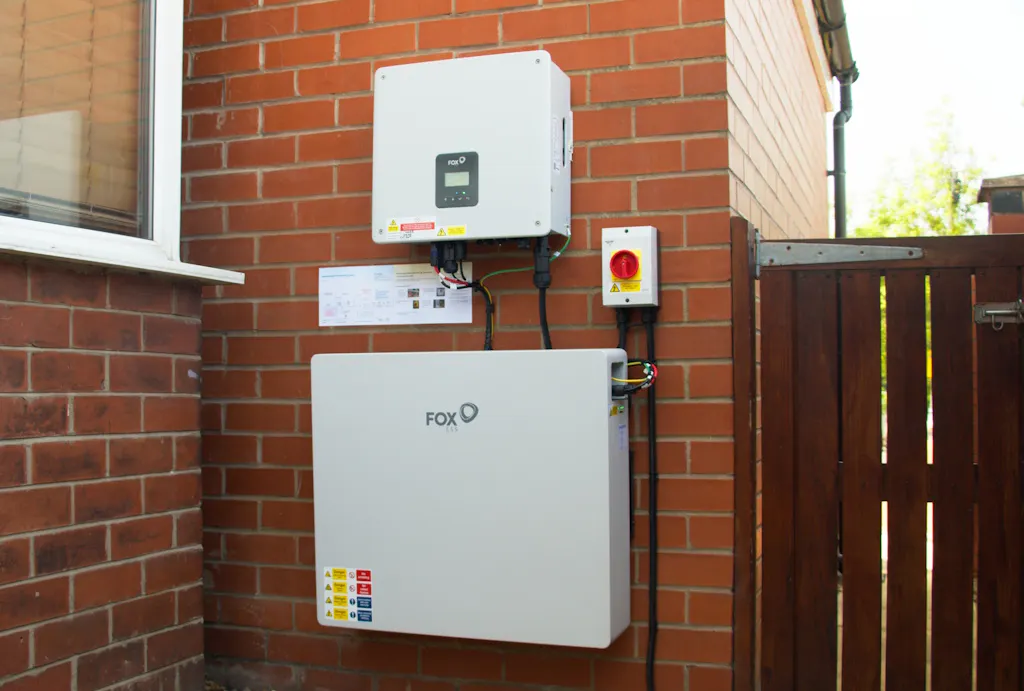
Fortunately, there's only one factor to consider, which is whether there's a suitable place for your roughly 0.5m² piece of cutting-edge technology to go.
A garage or outside wall is usually the perfect spot, though a battery can also go in a utility room or plant room, as long as it's not part of an escape route.
Your installer should ensure that your battery is well ventilated, next to a fireproof wall, and easily accessible to both you and engineers.
This is why the British Standards Institution and Institution of Engineering and Technology's newest BS 7671 regulations – which came into force in October 2026 – specifically say batteries shouldn't go in lofts.
Our home energy specialists will work with you to find a suitable spot for your battery.
How does a standalone battery save you money?
A standalone battery saves you money in two main ways: by allowing you to make the most of time-of-use tariffs, and by giving you access to virtual power plants.
Time-of-use tariffs come with peak and off-peak periods, which means you can get your battery to charge when electricity is cheap, then use that energy to power your home at other times.
With a large enough battery, you can cover most of your electricity consumption in this way, enabling you to save hundreds of pounds per year – simply by signing up to one of the best battery tariffs and setting a charging schedule. Your savings will depend on a few factors, such as your usage and tariff.
A 10kWh battery is about right for the average UK home, which uses 3,400kWh of electricity per year, or 9.3kWh per day. To find out more, read our guide explaining what size solar battery you need.
Battery owners can also join a VPP, which is a network of smart home tech that provides electricity, storage, or both to the grid. It's controlled by a company, and is designed to achieve savings for all participants.
Your VPP will pay you to import electricity during off-peak times, then send it to the grid in peak periods – which you'll already be profiting from, thanks to your time-of-use battery tariff.
Our smart algorithm, Sunsave Sona, maximises your savings by using intelligent scheduling to ensure your battery imports electricity at the lowest possible price.
And by joining Sunsave Sona, you also gain access to our Virtual Power Plant, which includes a guaranteed monthly payment of £15 for the first 12 months with Home Battery Plus – or for the first 18 months with Solar & Battery Plus.
Home Battery Plus customer Michael, who had a system fitted at his house in Crewe in July 2026, said: "I'm going to save £13 per month, after the finance is taken out."
He said he might be tempted to pay off the loan early, but added that "the interest over 10 years is about £1,000. I'll earn more than that in the bank." To find out more, read Michael's customer story.
Can you add solar panels later?
You can certainly add solar panels to your standalone battery at a later date, and doing so could save you hundreds of pounds more per year on your energy bills.
You may want to take this approach if your roof needs some work done before it's suitable for panels, but you want to start cutting your bills now.
If you get a battery by itself, it'll be AC-coupled – that is, wired into your home rather than panels (because you don't have them yet).
If it's a standard install, getting panels will mean you need a solar inverter to convert the DC electricity your panels produce into AC electricity your home can use – but if it's already fitted with a hybrid inverter, you won't need an additional model.
You can also add a battery to an existing solar panel system, if you want to do it the other way round – though the best way to save money is still to get a solar & battery system from the start.
What if you have a heat pump or electric car?
Whether you have a heat pump, an electric car, or neither, a solar & battery system will save you more money on your energy bills than a standalone battery.
Here's what you need to know.
Electric car
You'll need around 2,148kWh of electricity to drive the annual average of 7,100 miles, but this additional consumption won't affect your savings with a solar & battery system.
Instead of using solar electricity or your battery to power your car, it makes the most financial sense to sign up for one of the best EV tariffs, which all come with a cheap overnight off-peak rate that you can use to charge your car.
Even if you have solar panels that sometimes generate more electricity than your household can use, you should earn more by selling it to the grid than you'd save by using it to charge your car, as long as you're signed up to one of the best SEG rates.
Having an EV also won't significantly alter your savings with a standalone battery, as you'd only use your home battery to charge your car if you returned from a long day trip and wanted to top up your EV's battery before the nighttime off-peak period.
The main advantage you'll gain from having an EV and a battery (with or without solar panels) is access to EV tariffs, which are usually the best time-of-use tariffs around.
They allow you to charge your car much more cheaply, while also filling your battery with low-cost electricity that you can use to power a large chunk of your home's other usage.
Heat pump
Unlike an EV, it makes sense to use both solar panels and a battery to power a heat pump.
This is because heat pump tariffs' off-peak rates are usually more expensive than their EV equivalents; you'll often need to power your heating at peak times as well; and unlike EVs, heat pumps can't store energy for later.
There will be moments outside of off-peak hours when you want to run your heat pump, and you'll need to rely on your panels or battery during these times.
A heat pump increases the average household's electricity usage by around 3,200kWh per year, on top of the 3,400kWh it already uses.
Solar panels will save you money almost regardless of how much electricity you use, but they become more valuable when you increase your consumption.
And if you have a properly sized battery, you'll be able to charge it with off-peak electricity that you can use to run your heat pump outside off-peak hours.
Next steps
If your roof is suitable for solar panels, you should get a solar & battery system.
A good installer will work out whether you can go solar, but as long as your usable roof space is pitched, decently sized, has limited shading, and doesn't only face north, you'll probably be fine.
If not, a standalone battery can still save you a significant amount of money on your energy bills – and if your roof becomes suitable in the future, you can add panels at any point.
To find out which option is right for your home, enter a few details below and we’ll let you know.
Find out how much you can save
What kind of home do you live in?
FAQs




Related articles

 Josh Jackman
 Josh Jackman
 Charlie Clissitt
 Josh Jackman
Written byJosh Jackman
Josh has written about the rapid rise of home solar for the past seven years. His data-driven work has been featured in United Nations and World Health Organisation documents, as well as publications including The Eco Experts, Financial Times, The Independent, The Telegraph, The Times, and The Sun. Josh has also been interviewed as a renewables expert on BBC One’s Rip-Off Britain, ITV1’s Tonight show, and BBC Radio 4 and 5.