- Solar advice hub
- Exporting-to-the-grid
- Time-of-use tariffs: are they worth it?
Time-of-use tariffs: are they worth it?
Let's look at what time-of-use tariffs are, why they’re better now than they've ever been, and whether it’s worth switching to one.


Why you can trust our content
We know that the solar industry is full of misinformation, but we only use reliable sources, including:
- Our experienced solar experts, installers and system designers
- Our own database of solar & battery system designs
- Authoritative bodies like MCS and the UK government



Calculate savings
What kind of home do you live in?


Calculate savings
What kind of home do you live in?
Time-of-use tariffs: at a glance
Time-of-use tariffs have unlocked significant savings for UK households, allowing domestic electricity users to save hundreds of pounds more per year.
The spread of smart meters, as well as technology like electric vehicles and heat pumps, has made these tariffs possible and appealing, both for energy companies and customers.
In this guide, we’ll explain what time-of-use tariffs are, why they’re so much better now, and whether it’s worth switching to one.
They’re particularly beneficial to homes with a solar & battery system – and since they’re set to play a crucial role in expanding the grid, they should be around for the long term.
If you’re wondering how much you could save with a solar & battery system and the best time-of-use tariff for your household, enter a few details below and we’ll provide an estimate.
Find out how much you can save
What kind of home do you live in?
What is a time-of-use tariff?
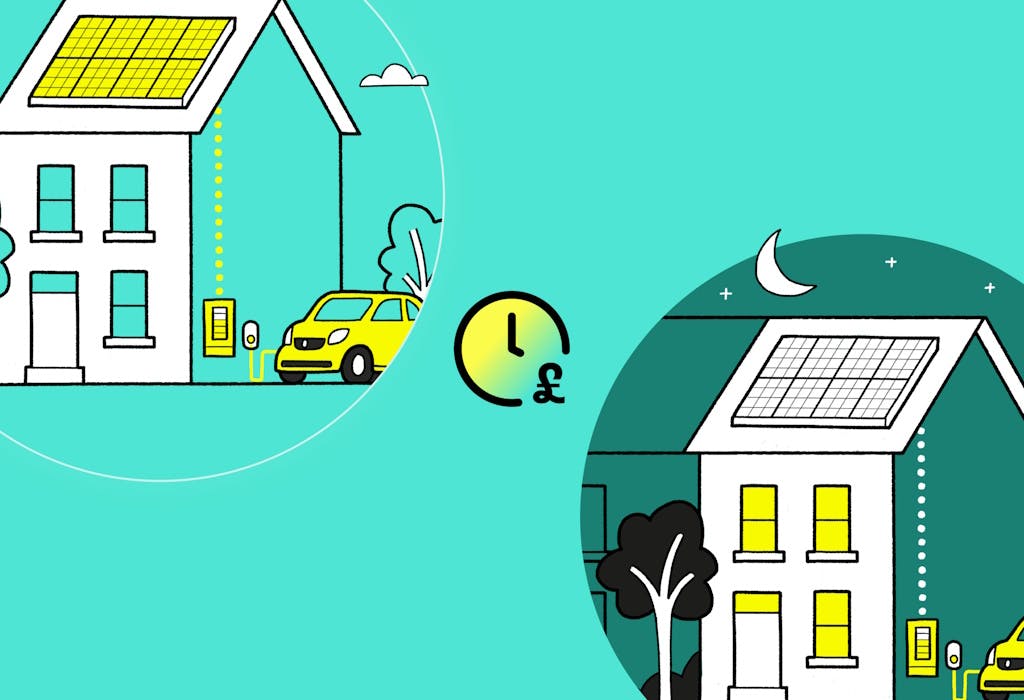
A time-of-use (TOU) tariff comes with peak and off-peak periods that change the price of your energy, depending on the time of day.
Usually, the off-peak period happens at night, and the peak rate takes place during the day, but can vary depending on the tariff.
For example, Good Energy EV Charge costs 8p per kilowatt-hour (kWh) from 12am to 5am, and about 33p per kWh at all other times.
This gives you the opportunity to save on your energy bills by scheduling your consumption for certain points of the day. For example, you could regularly set your dishwasher to run at night.
Energy companies use these tariffs to incentivise lower consumption levels at times when nationwide demand is high, typically from 4pm to 7pm. This way, they don’t have to buy electricity when it’s more expensive.
You’ll generally only find TOU electricity tariffs, as the gas grid copes better with peaks in demand.
When did they start?
The first TOU tariff in the UK was launched in October 1978.
These rates, known as Economy 7 tariffs, became popular in the 1970s and 80s – especially for homes with storage heaters.
Households could power these devices overnight, during the tariff’s seven off-peak hours, then leave them to slowly release their warmth throughout the day.
The number of homes signed up to an Economy 7 tariff has dropped since their peak, but 2.8 million UK households – about 10% – still use one.
This figure has actually ticked up slightly in recent years, probably as a reaction to the energy crisis that started in 2021.
These days, the average Economy 7 off-peak rate is 15.43p per kWh. This is certainly less than you’d pay on the January 2026 energy price cap, but a new generation of TOU tariffs offer much cheaper rates (find out more below).
Economy 10 tariffs were introduced in 2004, featuring 10 off-peak hours per day, but they’ve proven less popular among energy suppliers.
The new generation of time-of-use tariffs
New kinds of TOU tariffs have emerged in recent years, driven by the rising popularity of three technologies: electric cars, heat pumps, and smart meters.
There are dozens of tariffs in these different categories, each with slightly different benefits and drawbacks. Here’s more detail about each type.
1. Electric vehicles
A rapid 360% increase in EV ownership since 2021 has seen the number of electric car owners in the UK grow to 1.8 million.
This has led energy suppliers to release new TOU tariffs with these drivers in mind.
Npower created the country’s first TOU tariff for EV drivers – juice-e – in 2011, but the market was quiet until 2018, when Octopus Energy Go, British Gas Green Drive, and Scottish Power Smart Green EV all launched.
Then in the past few years, the number of EV tariffs has exploded, with around 20 now available to households – and we’ve ranked the 11 best ones, all of which can save you hundreds of pounds per year.
They all include an off-peak period, usually from 12am to 5am. The average rate across the top 11 options is 7.5p per kWh – twice as cheap as the average Economy 7 off-peak rate.
TOU EV tariffs usually provide five or six off-peak hours per day – rather than the seven offered by Economy 7 tariffs – but this should be long enough to charge your car sufficiently and run high-energy appliances like dishwashers.
2. Heat pumps
UK homes have started embracing heat pumps too: most of the country’s 340,000 installations have come since the beginning of 2022.
Good Energy introduced the first heat pump tariff in 2020, called Green Heat, but it wasn’t until September 2023 and the launch of Cosy Octopus that the trend really took off.
There are now six tariffs to choose from – and we’ve assessed and ranked the best ones.
Just like their EV counterparts, these tariffs provide cheaper and more expensive times to charge your device, though heat pump tariffs tend to be more complex.
They usually come with at least two off-peak periods and a peak time, while some offer five different pricing periods per day.
Any one of them can cut your electricity bills by hundreds of pounds per year though, so it’s worth it.
3. Smart meters
This tidal wave of TOU rates has been made possible by the spread of smart meters, which now make up 70% of all domestic meters.
As with TOU tariffs, the smart meter is a child of the 70s. American inventor Theodore Paraskevakos earned the first smart meter patent in 1974, but UK suppliers only started installing them in 2011.
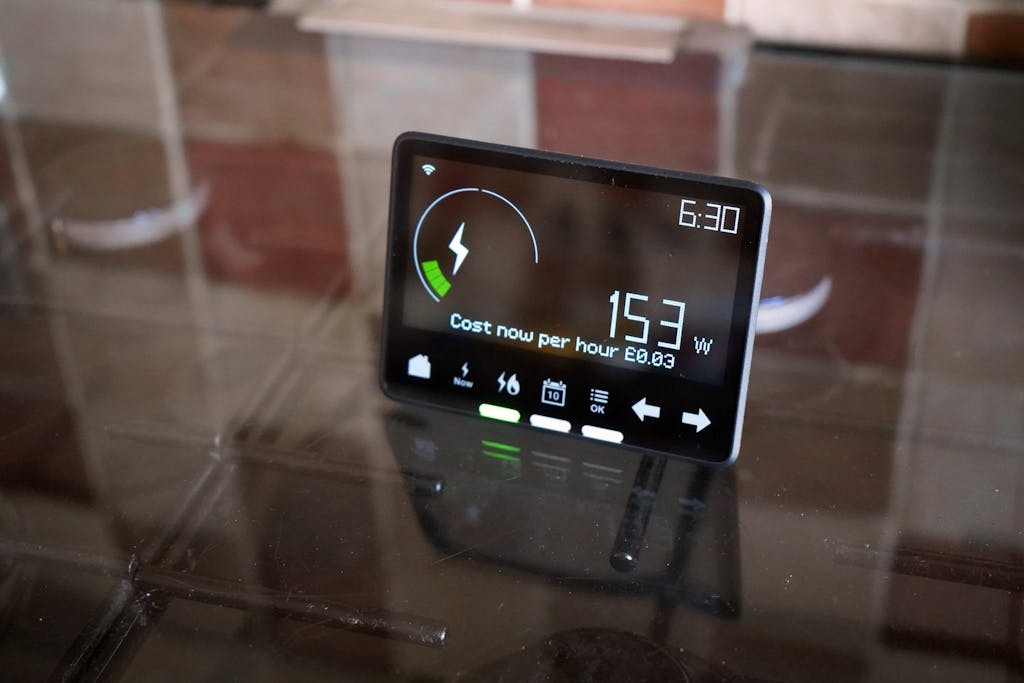
These devices measure how much energy your household uses on a half-hourly basis, meaning they send your supplier a meter reading every 30 minutes.
Your energy company can therefore track how much electricity you use – and when – which allows them to charge you accurately for your usage on a TOU tariff.
Smart meters let them offer rates that change up to every half-hour – and sometimes, they do. The most prominent example of this type of tariff is Agile Octopus, which isn’t specifically for heat pump or EV owners.
Households can sign up with just a smart meter, and get a distinct rate for every 30-minute period throughout the day. They can then benefit from shifting their electricity consumption to cheaper times.
What’s the benefit of time-of-use tariffs?
There are a couple of big benefits to TOU tariffs: they cut households’ electricity costs, and they help to maintain the grid.
Here’s some more detail about both of these advantages.
1. They can save you money
Households on TOU tariffs can cut their energy bills by shifting as much electricity usage as they can to off-peak times.
If you have an EV charger or a heat pump, you can massively cut your costs by prioritising cheaper periods of the day.
TOU tariffs may not suit homes that can’t move the times they use their electricity, but in reality most usage can be shifted – particularly with appliances that can be scheduled to turn on at specific times.
Homes with a solar & battery system can also benefit hugely from TOU tariffs, because you can charge your battery during off-peak hours, and use it as backup power during the day, if and when your panels aren’t producing enough for your whole home.
You can then export the rest of this low-cost electricity for a profit, before repeating this cycle during the next off-peak period.
There are also a couple of TOU tariffs that don't require an EV or heat pump, meaning solar homes without these technologies can still benefit.
We’ve calculated the top ways to benefit from this phenomenon in our guide to the best import-export tariff combinations for households with a solar & battery system.
2. They can help balance the grid
The other main benefit of TOU tariffs is their ability to help suppliers balance the grid, which can lower peak prices, prevent blackouts, and reduce the cost of maintaining the grid.
Renewable systems produce energy at an inconsistent rate that doesn’t match the UK’s peak usage periods, which is an issue, since supply has to be at a similar level to demand to avoid power cuts.
As green energy’s becoming increasingly popular, this mismatch is happening more often, making it harder to balance the grid – so sometimes when renewable power plants like wind farms are especially productive, the UK government pays to turn them off.
In 2025, the government spent £1.46 billion on this – which means higher energy bills for you.
Authorities are tackling the issue by building more – and better – power lines, creating more storage facilities, and reducing costs for suppliers that send electricity across long distances.
But for now, TOU tariffs are an effective way to convince homes to shift their demand to higher-producing periods of the day, in exchange for cheaper energy bills.
For example, when the wind blows especially hard or the sun shines very brightly, Agile Octopus customers can benefit from negative pricing, meaning they actually get paid to use electricity.
This encourages households to shift their usage, which means more electricity is used, and the government doesn’t have to intervene as often.
If you’re wondering how much you could save with a solar & battery system and a TOU tariff, enter a few details below and we’ll provide an estimate.
Find out how much you can save
What kind of home do you live in?
How popular are time-of-use tariffs?
TOU tariffs are quickly gaining in popularity among UK households.
Between April 2024 and July 2025, there was a 96% increase in the number of homes on smart TOU tariffs – which excludes Economy tariffs.
This means that 2.8% of households – or 835,000 – are now registered with a TOU tariff.
The main driver at the moment is EV tariffs, which are responsible for attracting 78% of TOU sign-ups – or 653,000.
The number of homes on EV tariffs has increased by 120% since April 2024, reflecting the public’s clear growing enthusiasm for more complex tariffs – as long as they result in savings.
49% of people say they’re fairly or very likely to switch to a TOU tariff, so we can expect the number of households joining one to keep rising in the coming years.
This impression is supported by the rapid growth displayed in the chart below, which shows the number of homes on smart TOU tariffs in every three-month period since October 2023.
Households on smart TOU tariffs, 2023-25
How much can you save on a time-of-use tariff?
You can save hundreds of pounds on a TOU tariff, though the exact amount will depend on how much of your electricity consumption you can shift to off-peak times.
Using your appliances’ scheduling functions can help with this process, while some devices – like EV chargers – come with apps that allow you to easily pick times for them to turn on.
Here’s how much the average household with an EV could save on a TOU tariff, depending on how much usage it shifts.
| Annual electricity consumption * | Cost on the Jan 2026 price cap | % used during off-peak window (12am-5am) ** | New cost † | Saving |
|---|---|---|---|---|
| 5,518kWh | £1,528 | 25% | £1,241 | £287 |
| 5,518kWh | £1,528 | 50% | £954 | £574 |
| 5,518kWh | £1,528 | 75% | £668 | £860 |
| 5,518kWh | £1,528 | 100% | £381 | £1,147 |
Are you eligible for a time-of-use tariff?
To be eligible for the most basic TOU tariffs – such as Agile Octopus, So Energy’s So Unique, and EDF’s FreePhase – you just need a smart meter.
After you’ve joined a standard tariff offered by one of the relevant suppliers, you can then switch to the TOU tariff in question.
This is also the sign-up process for Good Energy Heat Pump and Good Energy EV Charge, but that’s not the norm with heat pump and EV tariffs.
For now, most of these tariffs require you to own a heat pump or EV in addition to a smart meter, though some heat pump tariffs accept homes with other types of electric heating system.
Some offerings are more restrictive, such as Intelligent Octopus Go – which is only open to certain models of charger and EV – and Utility Warehouse EV Double Gold, which requires you to also join the supplier for two of your wifi, mobile, or boiler and home cover.
TOU tariffs are likely to become less restrictive as time goes on, since they’re so mutually beneficial for suppliers and customers.
Are time-of-use tariffs worth it?
TOU tariffs are absolutely worth it.
They can save you hundreds of pounds per month, particularly if you have a solar & battery system.
And they can also help smooth out the daily peaks that have traditionally been a fixed feature of our national electricity usage. This benefits suppliers, households, and the authorities running the grid.
This, in turn, means that energy companies have every reason to keep providing attractive TOU tariffs – so basing your long-term energy plan around one seems like a good idea.
If you’re wondering how much you could save with a solar & battery system and a TOU tariff, enter a few details below and we’ll provide an estimate.
Find out how much you can save
What kind of home do you live in?
Time of use tariffs: FAQs
Related articles
 Josh Jackman
 Josh Jackman
 Josh Jackman
 Josh Jackman
Written byJosh Jackman
Josh has written about the rapid rise of home solar for the past seven years. His data-driven work has been featured in United Nations and World Health Organisation documents, as well as publications including The Eco Experts, Financial Times, The Independent, The Telegraph, The Times, and The Sun. Josh has also been interviewed as a renewables expert on BBC One’s Rip-Off Britain, ITV1’s Tonight show, and BBC Radio 4 and 5.