- Solar advice hub
- Solar-technology
- Solar panel microinverters: are they worth it?
Solar panel microinverters: are they worth it?
Here's how microinverters work, their advantages and disadvantages, and whether they’re worth it for your home.


Why you can trust our content
We know that the solar industry is full of misinformation, but we only use reliable sources, including:
- Our experienced solar experts, installers and system designers
- Our own database of solar & battery system designs
- Authoritative bodies like MCS and the UK government



Calculate savings
What kind of home do you live in?


Calculate savings
What kind of home do you live in?
Microinverters: at a glance
When it comes to tackling unavoidable shading, microinverters are the best option on the market.
They can take the place of a regular string inverter, track your panels’ output, and maximise how much electricity they’re generating – but they’re only necessary for certain systems.
In this guide, we’ll run through how microinverters work, their advantages and disadvantages, and whether they’re worth it for your household.
If you’re wondering how much you could save with a solar & battery system, click the button below, enter a few details, and we’ll provide an estimate.
Find out how much you can save
What kind of home do you live in?
What are microinverters?
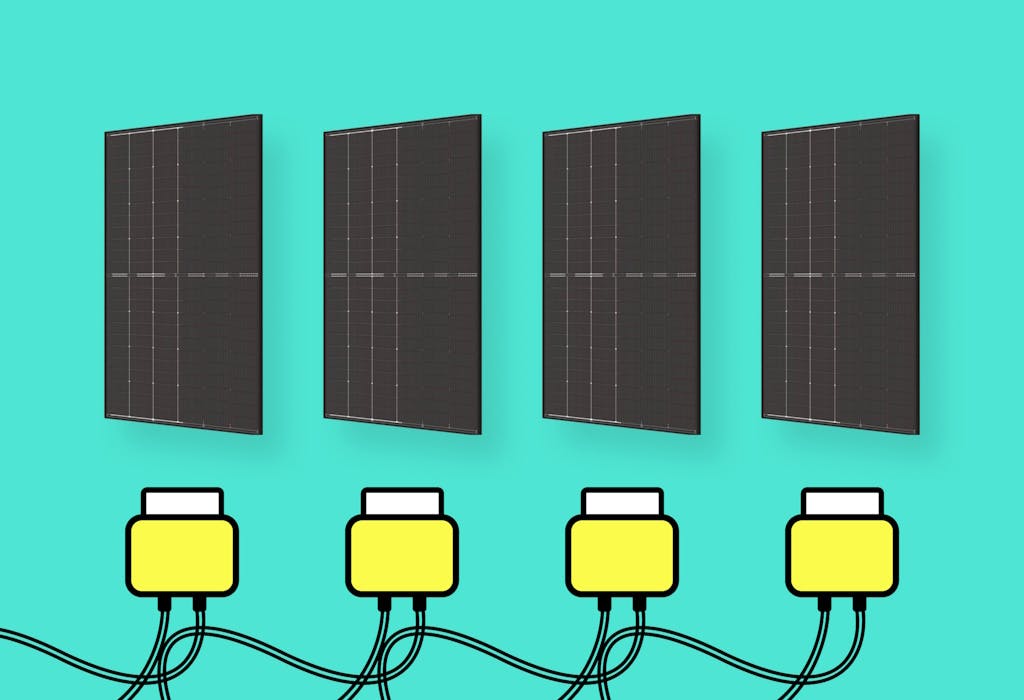
Microinverters are small boxes that convert the direct current (DC) electricity your solar panels produce into alternating current (AC) electricity that you can use in your home.
These pieces of module-level power electronics (MLPE) technology are installed at the same time as your solar panels, usually at a rate of one per panel.
The device’s roots go back to the 1980s, when researchers at Germany’s Fraunhofer Institute for Solar Energy Systems started designing prototypes, but it only hit the mainstream with Enphase’s 2008 model.
A traditional string inverter also converts DC electricity into AC electricity, but it connects to all your solar panels, and treats them as one entity.
In contrast, microinverters take care of one panel each, so they can improve solar output at times when an underperforming panel would otherwise drag down the entire system (more on this in the next section).
An installer will place them on the back of your panels, with their AC cables connected to your consumer unit (also known as a fuse board), and their DC cables running to your panels.
How do microinverters work?
Both microinverters and string inverters use a technology called Maximum Power Point Tracking (MPPT) to increase how much electricity they produce, but with one important difference.
A string inverter can only control a system as a whole, so it’s forced to operate every panel at the same level as the worst-performing one (i.e. “in series”), whereas microinverters can run each panel at its maximum level (i.e. “in parallel”).
For example, in a system where one panel is generating 90% of its peak power rating and the rest are working at 95%, a string inverter would have all the panels run at 90%.
Microinverters, on the other hand, would ensure that each individual panel reaches its maximum capability, without being affected by the others.
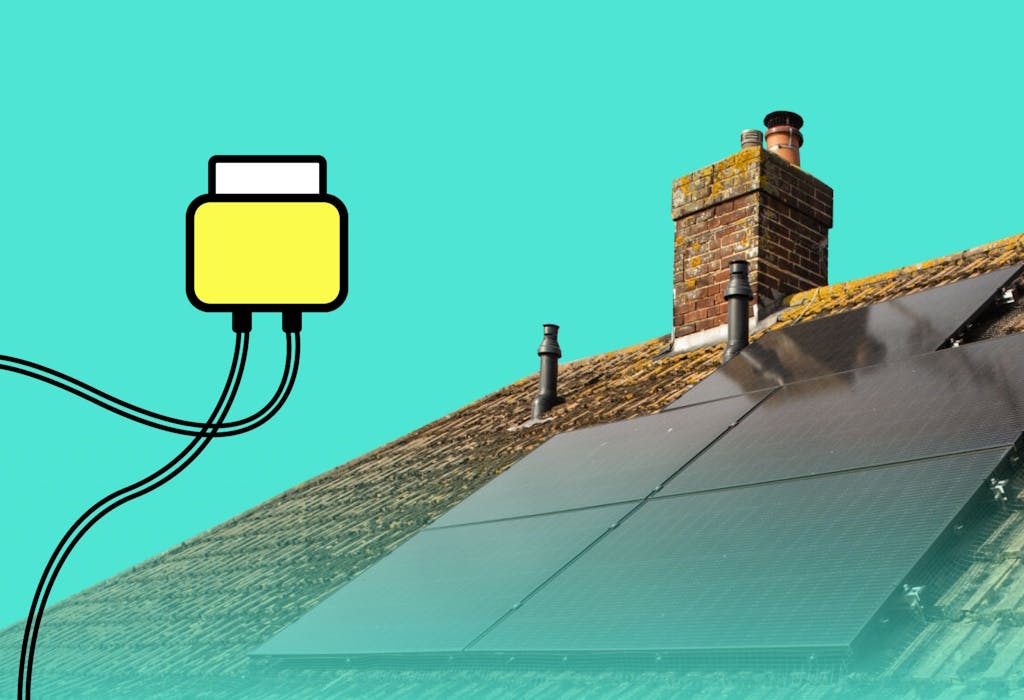
This can be particularly helpful if your panels face multiple directions, or if some of them experience significant levels of unavoidable shading.
When are microinverters needed?
Your solar panel system may need microinverters if it experiences a certain level of partial shade or dirt accumulation, but they should be your installer’s last port of call.
First, they should try to design your system as intelligently as possible by avoiding any shaded parts of your rooftop.
If there's a degree of unavoidable shading, or if panels are going to be facing in multiple directions, your installer should isolate groups of panels by putting them on different inverter strings.
That means that the output of one string won't affect the output of the other strings. Your system will likely have two to four strings, depending on the size of the inverter and how many panels you’re getting.
Solar panels also tend to come with bypass diodes (usually three per panel), which all protect the system’s generation levels when shading on their section of the panel reaches 20%.
But if intelligent system design, multiple inverter strings, and bypass diodes can’t solve your solar panel shading issues, it may be worth getting microinverters. A good installer will work out which option is more cost effective.
If you’re wondering how much you could save with a solar & battery system, click the button below, enter a few details, and we’ll provide an estimate.
Find out how much you can save
What kind of home do you live in?
How much do microinverters improve output?
MLPE technologies, including microinverters and optimisers, can reduce solar output losses from partial shading by 25-35%, according to the National Renewable Energy Laboratory.
This is based on a 2016 study, because independent, peer-reviewed studies measuring microinverters’ impact on output in shady conditions have been few and far between in recent times.
A more recent estimate from EcoFlow states that microinverters “helps systems achieve up to 5–25% more total energy over a year in shaded or mixed-orientation setups.”
But microinverters don’t always help
If microinverters will only be of limited use, it’s usually not worth the extra expense.
And a 2021 study by researchers at Limoges University in France found that they’re not inherently better than string inverters.
The scientists compared the performance of solar panel systems across France – 100 that used microinverters against 100 equipped with string inverters – with no significant winner.
All 200 of these systems were standard residential installations, meaning none of them were particularly shaded or had to deal with an unusual number of orientations.
The group said: “According to the production data, the performance ratio is ultimately almost identical for installations with inverters or microinverters.”
These results were not affected by the systems’ locations or orientations.
However, the study did correctly identify that microinverters have a longer lifespan of around 25 years, whereas string inverters usually need replacing after about 14 years.
How much do microinverters cost?
Microinverters cost around £175 per solar panel.
So if you have 12 panels, you’ll pay roughly £2,100 to get microinverters.
A string inverter for a 12-panel system costs around £1,400, meaning microinverters are around 50% more expensive.
You’ll also need to get an AC-coupled battery, which tends to cost more than buying a DC-coupled model.
To get an AC-coupled battery, you’ll need approval from your Distribution Network Operator (DNO) – that is, the company that runs the hardware supplying your region of the UK with electricity.
This process will be free, but if you want a professional to deal with it for you, your installer may do it for a fee.
What size microinverters do you need?
Microinverters are sized the same way as solar panels, in watts (W). The size of a microinverter should roughly match the size of the panels it's connected to.
Your installer may fit one microinverter for every panel, or one for every two panels, depending on the model they choose.
So if you have 10 panels, each with a peak power rating of 450 watts (W), they could get 10 microinverters that are all roughly 450W each.
Or they may install five microinverters, all around 900W. Both of these are standard sizes for domestic installations.
In either case, deciding on the size of your microinverters won’t be your responsibility. Your installer should assess whether you need microinverters, then design a setup that’s tailored to your needs.
The pros and cons of microinverters
Microinverters will almost certainly increase the output of systems that can't be helped with multiple inverter strings – but this comes at a price.
The larger and more complicated your system is, the more appealing microinverters will be, but the point at which you should get microinverters instead of a string inverter is tricky to work out on your own.
That’s why it’s best to get a free assessment and quote from one of the best solar installers in the industry – like us – before making your final decision.
The benefits of microinverters
 They minimise output problems caused by shade and multiple orientations. Microinverters will stop underperforming panels from affecting others in your system, and potentially increase output by 5-25%.
- You can increase your savings and earnings. With each panel producing as much electricity as it can, you can lower your grid electricity imports and sell more excess electricity via an export tariff.
- Monitoring is considerably better with microinverters. You can track every panel that’s connected to a microinverter, allowing you to immediately identify any faults.
- Microinverters work in low light. While string inverters generally need between 60 and 200 volts to start producing electricity, microinverters usually require just 20-30 volts. This means they can make the most of the daylight.
- They have long lifespans. Microinverters usually come with 25-year warranties, whereas a study in 2023 by Bern University of Applied Sciences found that 34% of string inverters fail by year 15.
- You won’t need any high-voltage DC wiring on your roof. Microinverters perform the DC-to-AC conversion at source. This reduces the chances of incorrectly fitted or damaged wiring starting a fire – though the probability of this is already miniscule.
The drawbacks of microinverters
 Microinverters are usually around 50% more expensive than string inverters. This may be worth it if they massively improve your solar output, but in many cases they’re not cost-effective.
- Any maintenance issues would be costly. An engineer would require scaffolding to access the microinverters, whereas string inverters are a lot more accessible, since they’re usually in a garage or outside.
- You’ll need an AC-coupled battery. If you’re planning to get solar panels with microinverters, and you want to add a battery to boost your returns, it’ll need to be AC-coupled. These models tend to be slightly less efficient and more expensive than DC-coupled batteries.
How long do microinverters last?
Microinverters usually last around 20-25 years.
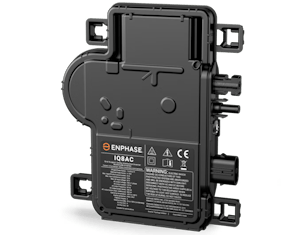
Two of the largest microinverter manufacturers are Enphase and APsystems. Enphase’s 25-year warranty requires that your microinverters be connected to its IQ Gateway product, while you can extend APsystems’ 12-year warranty to 25 years for a fee.
This is about twice as long as the warranties you’ll get for string inverters, which usually last 10-12 years.
Microinverters are also more reliable, according to an analysis of 100,000 solar installations by California-based company Solar Insure.
The 2017 to 2023 study found that in the two years after installation, 0.89% of string inverters failed, compared to just 0.0551% of microinverters.
That means 16 times more string inverters broke down.
Solar panels generally last 30-40 years, so while you’ll probably end up replacing some of your microinverters as they age, it’s not a given.
And either way, you shouldn’t have to worry about getting any new microinverters for a couple of decades.
Do they require any maintenance?
Microinverters don’t usually need any maintenance. For example, top manufacturer Enphase says their microinverters require “virtually no maintenance”.
Like any machine, they can suffer faults and break down, but this is generally very rare.
On the off-chance it does happen, you should be able to quickly spot any problems, as long as you’re regularly monitoring your panels’ output.
Any repairs can be more costly than they would be for a string inverter, as you’ll need to have scaffolding put up so the electrician can get on the roof.
String inverters don’t go on the roof, so you won’t need scaffolding to reach them.
It’s therefore worth checking if your warranty covers repairs, and if it does, reading on to see whether labour and scaffolding costs are included.
Every Sunsave Plus system is protected by the Sunsave Guarantee, which includes 24/7 monitoring, maintenance, a free battery upgrade, a free replacement inverter if necessary, and downtime cover.
Your system will also be insured by Aviva against damage, fire, and theft. Check out our guide to the Sunsave Guarantee to learn more.
Microinverters vs optimisers
Like microinverters, optimisers are small boxes that are wired into solar panels, measure their generation, and use MPPT to ensure they generate the most electricity possible – but they can’t replace an inverter.
Optimisers are generally around three times cheaper than microinverters, but they’re also more temperamental.
Solar Insure’s six-year study showed that one in 1,500 microinverters fail, compared to one in 1,300 optimisers – which is a 15% higher failure rate for optimisers.
So if your system is often in shade, microinverters will likely justify their higher price.
Microinverters are usually installed on every panel, to ensure your monitoring is as effective as possible, while some big optimiser brands like Tigo are open to customers just putting optimisers on as many or as few panels as they choose. This could also affect your price.
They can also produce electricity in lower light than optimisers. Their startup voltage is around 20-30 volts, compared to the 60-200 volts that optimisers require on a string inverter.
Verified expertMicroinverters are a lot better than optimisers. They’re much more resilient and reliable, and tend to come with longer warranties. With optimisers, you’re likely to end up paying for some pretty expensive maintenance during the lifetime of your solar panels.
Andrei Stavila
Technical Manager at Sunsave
Andrei has worked in residential solar installation for more than 17 years, and is a fully qualified electrical engineer.

Are microinverters worth it?
Microinverters may be worth it if you need to tackle significant, unavoidable shading issues, or if you have panels facing multiple directions.
However, they are expensive, and should therefore only be added to a system when it’s absolutely necessary.
Even if they make your solar panel system function better, their high cost may end up pushing back your break-even point.
Before deciding on the shape and nature of your solar panel system, it’s worth seeing what can be done with smart system design – which a trusted installer can help you with.
If we think microinverters would be worth it for your system, we’ll recommend them and explain why.
If you’re wondering how much you could save with a solar & battery system, click the button below, enter a few details, and we’ll provide an estimate.
Find out how much you can save
What kind of home do you live in?
Microinverters: FAQs


Related articles
 Josh Jackman
 Melody Abeni
 Josh Jackman
 Josh Jackman
Written byJosh Jackman
Josh has written about the rapid rise of home solar for the past seven years. His data-driven work has been featured in United Nations and World Health Organisation documents, as well as publications including The Eco Experts, Financial Times, The Independent, The Telegraph, The Times, and The Sun. Josh has also been interviewed as a renewables expert on BBC One’s Rip-Off Britain, ITV1’s Tonight show, and BBC Radio 4 and 5.