- Solar advice hub
- Costs
- Are solar panels worth it in the UK?
Are solar panels worth it in the UK?
Solar & battery systems can save you 94% on your electricity bills. Here's how that works, how much you'll pay, and how you can earn on top of your savings.


Why you can trust our content
We know that the solar industry is full of misinformation, but we only use reliable sources, including:
- Our experienced solar experts, installers and system designers
- Our own database of solar & battery system designs
- Authoritative bodies like MCS and the UK government



Calculate savings
What kind of home do you live in?


Calculate savings
What kind of home do you live in?
What you need to know
The biggest concern for households thinking about going solar is whether the installation will be worth the investment.
For some homes, the answer will be no – but for millions of others, switching to solar can mean saving hundreds of pounds per year on energy bills.
As long as your roof, electricity usage, and location are suitable, you should be able to cut your bills for decades to come – as long as you can afford the cost.
In this guide, we'll help you work out whether solar panels are right for you, by running through all the costs, savings, and suitability criteria – and whether you should add a battery.
If you’re wondering how much you could save with a solar & battery system, enter a few details below and we’ll provide an estimate.
Find out how much you can save
What kind of home do you live in?
Is it worth getting solar panels in the UK?
Solar panels are an excellent choice for many homes in the UK, but not everyone.
Even as a solar installer, we're very upfront that the technology doesn't work for some households.
There are some groups who simply can't go solar, such as those who don't own their home, most people who live in a flat, many households with a flat or metal roof, and a lot of people in conservation areas.
For these households, a standalone home battery is a great alternative, as you can use new tariffs to substantially cut your energy bills. To learn more, read our guide to home battery storage without solar.
A sizeable number of homes could go solar though, and should seriously consider it – after all, the technology is extremely reliable, and a solar & battery system can cut your electricity bills by 94% on average.
This is based on projected first-year savings from a sample of over 600 systems installed by Sunsave across the UK in 2025. The average system is 5 kilowatt-peak (kWp), with 44% of solar electricity used at home and 56% exported to the grid.
Actual savings with solar will vary depending on several factors, including your property and system. More on this below.
If you can get solar panels, it’s usually well worth making the switch if you have one (or more) of these things:
 Ample roof space
- A south-, west- or east-facing roof
- Medium or high electricity usage
- An EV and/or a heat pump
- A home in a sunny location
Here’s some more detail on each of these.
Ample roof space
This is the most important deciding factor. If you have plenty of roof space, you can get a larger number of solar panels, which usually makes it well worth going solar.
Panels form a relatively small part of the installation cost, and most of the other elements – such as scaffolding – come with fixed costs, so there's little downside to filling your roof.
The more panels you have, the more electricity you can produce, and the higher your savings and earnings – all other things being equal.
The average residential system installed in the UK in 2025 was 4.9kWp, which adds up to 11 panels if you're using 450-watt (W) models – and this requires around 34.78m² of roof space.
Modern panels are around 1.134m² wide and 1.762m² long – which adds up to roughly 2m² – but a good installer will also leave 3cm of space between every panel, and 40cm on each side of the system.
This matches guidance from certification schemes like MCS and Flexi-Orb, and means each panel ends up requiring slightly over 3m² of space.
It can be worth going solar with a smaller roof, as long as you can fit at least six or so panels up there.
A south-, west- or east-facing roof
Solar technology has improved significantly in the past 15 years, meaning you no longer need a south-facing roof to go solar – a roof facing east or west is more than suitable.
Modern solar panels are around 20-25% efficient, which is a massive leap forward from the roughly 15% efficient panels you'd find in the early 2010s.
As a result, roofs previously considered sub-optimal now take in enough daylight to make a solar installation worth it.
We’ve installed many systems on east- and west-facing roofs that produce lots of electricity.
Homes that only have space on a directly north-facing roof are still rarely worth installing on in the UK – but if it's part of a larger installation that also faces other directions, it can be worth it.

Medium or high electricity usage
In most cases, you'll benefit more financially from using your solar electricity, rather than exporting it to the grid.
Replacing grid electricity with solar energy will save you around 25p per kWh, while the average household made 13p per kWh from selling electricity to the grid in 2024-25.
You need to consume enough electricity at home to make it worth replacing with solar energy, though.
As we mentioned earlier, the average system size in 2025 was 4.9kWp, which with average UK irradiance of 900 kilowatt-hours (kWh) per kWp, accessed August 2026 would produce 4,410kWh per year.
The more of this electricity you self-consume, the better for your savings. The average UK household uses 3,400kWh per year, which is more than enough to significantly cut your electricity bills.
If you use even more – say, 5,000kWh – this would lead to even bigger savings, but homes that only consume around 1,000kWh per year would end up exporting most of the electricity a typical system generates.
More and more UK households will fall under the first category in the coming years. The independent Climate Change Committee has estimated that by 2050, annual electricity demand could be more than double what it was in 2023.
This is largely down to the millions of homes getting energy-intensive air con units to make our increasingly hot summers bearable, electric vehicles to save on fuel costs, and heat pumps to cut their heating bills (see next section).
An EV and/or heat pump
EVs and heat pumps are both becoming widespread in the UK.
There are now 2.1 million fully electric cars on these shores – and in the first seven months of 2026, they made up 25.3% of all new car registrations. In 2021, that figure was just 11.6%.
And more than 340,000 households have now had heat pumps installed, with the great majority of these being fitted after 2020.
Both of these devices run on electricity, which can be supplied by solar panels. You could save hundreds of pounds per year in charging and heating expenses in this way.
But the real win here is that both EVs and heat pumps unlock access to the best time-of-use import (TOU) tariffs. These allow you to use cheap off-peak periods to power your EV, heat pump, and/or home battery for less.
We go into more detail about TOU tariffs and how they work with solar setups further down.
The cheapest rates tend to be designed for EV or heat pump owners. Check out our guides to the best EV tariffs and the best heat pump tariffs to learn all about them.
A home in a sunny location
Solar panels just need daylight to work, not direct sunlight, which is why they work well all over the UK.
As a case in point, our 94% savings figure is based on systems across England, Wales, and Scotland – not exactly the three sunniest countries in the world.
Solar panels do work better when the sun's blazing down though, so if you live in one of the sunniest places in the UK, like southern England, you'll save more with solar panels than you would in northern Scotland – everything else being equal.
A household on the Isle of Wight, for instance, could generate 5,841kWh per year with a south-facing 4.9kWp system on a 35-degree roof – but the same setup in Inverness would produce just 4,233kWh per year.
These figures are both sourced from the European Commission’s PVGIS tool, which based its calculations on a rooftop system of monocrystalline solar panels.
What about plug-in solar panels?
Plug-in solar panels have been in the news since spring 2026, when the UK government first announced that a review of the regulations would lead to them being available to buy and self-install “within months”.
After that review, the government created legislation around plug-in panels that's due to come into force on 27 August, allowing all UK homes to purchase and fit them.
The technology could make a meaningful difference to people who don't own their home or have any roof space they can use, and therefore aren't able to get traditional rooftop solar panels.
People living in flats with balconies could particularly benefit, though there are some safety concerns that should be resolved first. To learn more, read our guide to plug-in solar panels.
However, when it comes to plug-in batteries, it's unsafe and against regulations to install them yourself. They must be professionally fitted on a dedicated circuit, like any other device that can feed electricity into your home.
There's no immediate path to changing these regulations either, as plug-in batteries come with even more significant safety concerns than plug-in panels.
What’s the average cost of solar panels?
A typical solar & battery system for the average UK home costs about £12,000, including installation.
Annual electricity usage | Kilowatt-hours (kWh) | System size (kWp) | No. of solar panels (450W) | Estimated cost | Estimated cost + 10kWh battery |
|---|---|---|---|---|---|
Low | 2,000 | 3.15 | 7 | £5,695 | £9,695 |
UK average | 3,400 | 4.95 | 11 | £8,029 | £12,029 |
High | 5,000 | 6.75 | 15 | £10,949 | £14,949 |
These costs are of course just estimates, and can vary widely on a whole range of factors, including the size of your system and the complexity of the installation. For more information, read our guide to solar panel costs.
This is a great time to get a solar & battery system, as there’s currently 0% VAT on both panels and batteries – but the high upfront cost makes it unaffordable for many homes.
About half of UK households have less than £5,000 in savings, according to the Financial Conduct Authority (FCA), which puts solar panels out of reach for millions.
If you’re feeling put off by the high upfront cost of solar, Sunsave Solar & Battery Plus allows you to go solar with no upfront cost, and spread the cost out with fixed monthly payments over a long period of time.
This comes with the Solar & Battery Guarantee, which includes 24/7 monitoring, maintenance, free replacement parts, downtime cover, and insurance for the length of your contract.
If you’re wondering how much you could save with a solar & battery system, enter a few details below and we’ll provide an estimate.
Find out how much you can save
What kind of home do you live in?
Are there any grants or loans for solar?
There are currently eight grant or loan schemes run by the government, which provide funding towards solar installations in different parts of the UK.
These include the UK-wide Warm Homes Plan, England's Warm Homes: Local Grant, and two Welsh schemes: the Warm Homes Nest scheme and Green Homes Wales.
However, all these initiatives come with stringent requirements meant to ensure that only low-income or otherwise deprived households get free or largely subsidised solar panels.
If you're eligible, solar panels make up 18% of the measures handed out by these four schemes, overall.
At this moment, the government isn't offering any solar grants that are open to all homes.
For more information, read our full guide to solar panel grants.
To see which schemes you could qualify for, use our grant eligibility checker.
What about the Warm Homes Plan?
The £15 billion Warm Homes Plan, which was announced in January 2026, aims to put solar panels on "up to three million more homes" by 2030 – but it's still unclear when funding will be released, who will benefit, and how it'll all work.
The government's plan is for solar funding to be available through two paths.
The first, worth £5 billion, will target England’s low-income and fuel-poor homes with free upgrades including solar panels and batteries.
The second, the £2 billion Consumer Loans scheme, will provide low- or zero-interest loans to domestic owner-occupiers – meaning it could be open to around 16 million households in England.
For more information, check out our guide to the Warm Homes Plan.
How much can you save with solar panels?
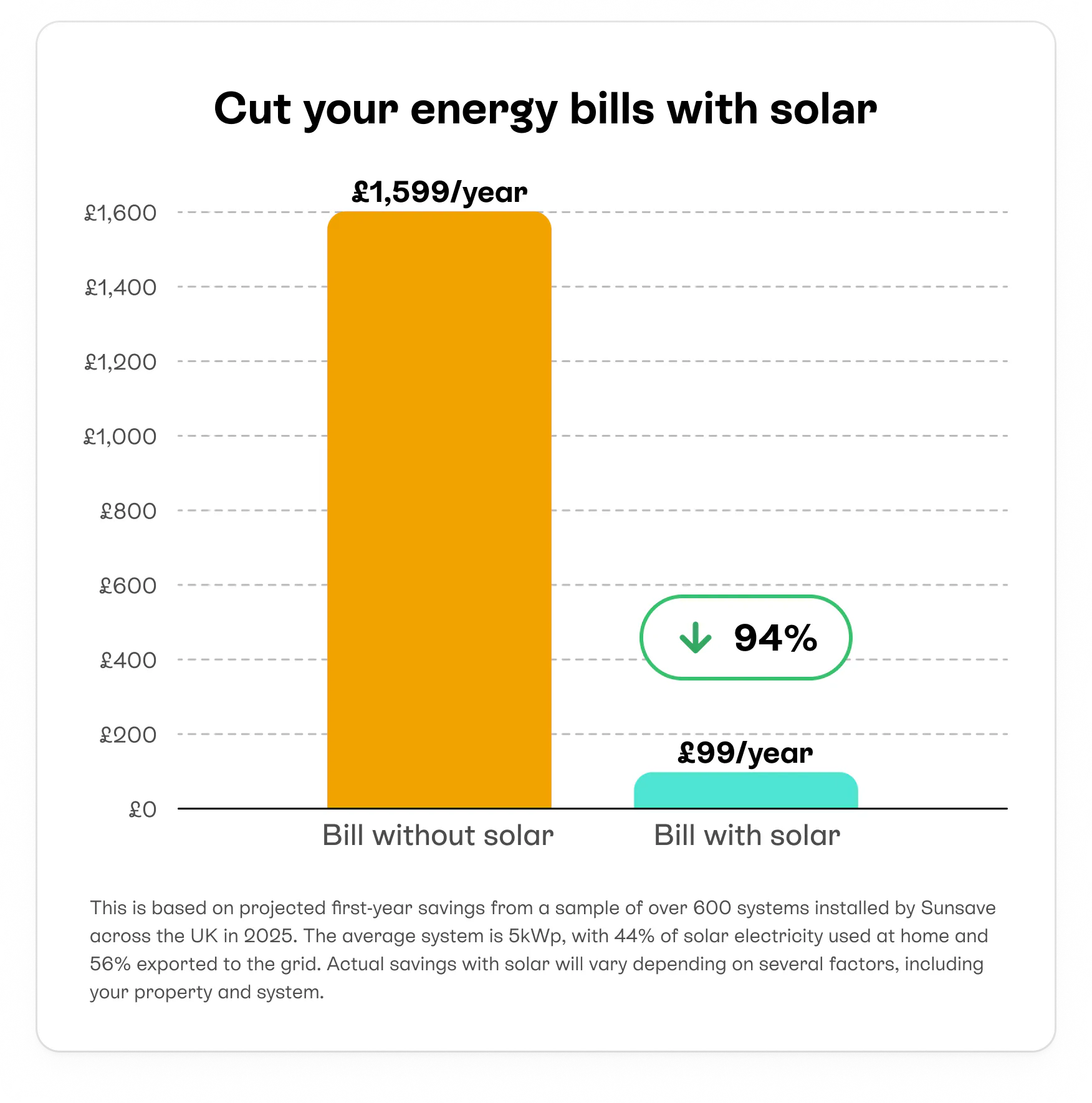
A solar & battery system can cut your annual electricity bill by 94%, on average.
This is based on projected first-year savings from a sample of more than 600 systems installed by Sunsave across the UK in 2025. The average system is 5kWp, with 44% of solar electricity used at home and 56% exported to the grid.
Your household's solar savings will vary depending on multiple factors, including your roof, system, and location. To find out more, read our guide on the subject, How much do solar panels save you on your energy bills?
There are multiple reasons why solar & battery systems provide such impressive savings:
- Reduced electricity imports
- Time-of-use tariffs
- Export income
- Virtual power plants
Let's dive into each one in more detail.
We’re saving about £400 each year, which is great. My main goal through Sunsave Plus was to cancel out my current energy bill, but now the system is actually paying for itself.
Tim
Sunsave customer
Got Sunsave Plus in June 2024

Reduced electricity imports
You can significantly decrease the amount of electricity you buy from the grid, since you’ll be able to replace much of it with solar-generated electricity.
And every time you use the power produced by your own panels instead of importing it from the grid, you’ll save money.
The chart below shows roughly how this could work for a UK household across the year.
In winter, your panels will reduce your grid imports by around 25%, and you’ll produce more solar-generated electricity in the summer months, allowing you to cut your reliance on the grid in half.
Electricity imported before and after solar
Export income
In the summer months, your solar panel system will likely generate more electricity than your household can consume, even if you store some of it in a battery for later use.
Signing up to an export tariff allows you to easily sell this excess electricity to the grid, potentially earning hundreds of pounds per year. This means you can make money from electricity you would have sent to the grid anyway.
A typical home can earn £675 per year in export income by signing up to EDF Export 12m.
This is based on a household with a 4.9kWp solar panel system, 10kWh battery, and solar irradiance of 900kWh per kWp, which uses 3,400kWh per year (the UK average, and exports 65% of its solar electricity.
However, that figure will likely only stay true for a while. This is an ever-changing market in which suppliers regularly lower and raise rates, withdraw tariffs, and introduce new ones, all with little to no fanfare.
Fortunately, we track it incredibly closely, meaning you can always get the newest information – and the best import-export tariffs combinations – by checking our guide to the best SEG rates.
On average, export rates have been steadily increasing ever since the Smart Export Guarantee (SEG) began in 2020, as shown by the chart below – but to take full advantage, you need an accurate summary of the current tariffs.
The growth of solar export tariff rates, 2020-25
Time-of-use tariffs
Time-of-use (TOU) tariffs include peak and off-peak periods at different times of the day, which offer higher or lower prices for the same energy.
If you use significantly more electricity at off-peak times than you do during peak times, you could save money compared to being on a flat rate tariff.
This is easier to achieve with a solar battery, which you can top up with cheap, off-peak electricity whenever your panels haven't generated enough excess energy to fill it.
This way, you'll purchase less grid electricity – because you're replacing a large chunk of it with solar electricity – and when you do buy some, you'll pay less.
As mentioned earlier, the best TOU tariffs are available to EV and heat pump owners, but there are still some excellent choices for homes with a solar & battery system.
To find out more, check out our guide to time-of-use tariffs.
Virtual power plants
A virtual power plant (VPP) is a group of small renewable generators, home batteries, and/or smart devices that a company controls in order to earn money for all participants.
The VPP withdraws electricity from the grid during off-peak periods, stores it, and sells it during peak times, both to balance the grid and to make a profit.
This allows households to benefit from energy trading, to a much greater extent than they could by themselves.
Only with a VPP can you access wholesale trading, or the flexibility services offered by your Distribution Network Operator (DNO) – the organisation that runs the hardware supplying your area of the UK with electricity.
VPP operators aim to maximise your earnings, but it's crucial that you find one that also looks after your battery, as overcycling can lead it to break down before its time.
For more information, read our guide to virtual power plants.
And if you’re wondering how much you could save with a solar & battery system, enter a few details below and we’ll provide an estimate.
Find out how much you can save
What kind of home do you live in?
When do you break even on solar panels?
It takes just over eight years for a solar & battery system to pay for itself, on average.
This is based on a sample of over 150 solar & battery systems installed by Sunsave across England and Wales in 2024. The average system size is 6.1kWp, with 51% of solar electricity used at home and the other 49% exported to the grid, on average.
Payback periods vary substantially across different installations, though.
Solar panel payback period: examples around the UK
County | System size (kWp) | Battery size (kWh) | Annual consumption (kWh) | Electricity generated (kWh) | Payback period |
|---|---|---|---|---|---|
Northamptonshire | 5.16 | 8.7 | 6,618 | 5,131 | 7.1 years |
County Durham | 12.47 | 14.5 | 9,173 | 10,479 | 6 years |
Shropshire | 10.3 | 6 | 15,737 | 9,311 | 6.7 years |
East Riding of Yorkshire | 10.75 | 8.7 | 10,231 | 8,226 | 5.1 years |
Gloucestershire | 4.73 | 5.2 | 2,776 | 4,133 | 7.5 years |
Buckinghamshire | 11.18 | 11.6 | 9,134 | 9,091 | 5.6 years |
Cornwall | 4.3 | 5.8 | 2,375 | 4,308 | 7.2 years |
Is it worth getting a battery too?
It's generally worth getting a battery with your solar panels.
However, this is a common question – and one worth asking, since a battery usually adds thousands of pounds to your upfront cost.
Since 2020, batteries have become a mainstay of solar installations, to the extent that 94% of new solar panel installations in the UK now include a battery, according to data from Flexi-Orb and EPVS.
There are a few good reasons for this. A battery allows you to substantially increase the amount of solar electricity you use at home, access the best export tariffs and a better class of TOU tariffs, and join a VPP.
All put together, this can boost your solar returns by hundreds of pounds per year. To learn more, check out our full guide to solar battery storage.
How long do solar panels last?
Monocrystalline solar panels usually last between 30 and 40 years, giving the average household 22-32 years of pure profit after breaking even. These black panels are currently used in the majority of installations.
Polycrystalline solar panels, which are blue, generally last 25-30 years – though they're now a thing of the past. They make up 0% of all solar panel production, according to the National Renewable Energy Laboratory.
Your battery’s lifespan will be shorter, as they tend to seriously decline after 10-12 years, so you’ll need to replace it before your panels. With Sunsave Solar & Battery Plus, you can get a free battery upgrade, as you’ll be covered by the Solar & Battery Guarantee.
You can also get a free replacement inverter through this guarantee, which is fortunate since 34% of inverters fail by the end of year 15, according to a Bern University of Applied Sciences study.
For more information on solar panels’ lifespans, check out our full guide to how long solar panels last.
Do solar panels require maintenance?
Solar panels are resilient enough to function productively for decades, but like all household appliances, they require the odd bit of maintenance.
Some technical experts in the industry estimate a solar & battery system will need three maintenance call-outs across a 20-year period - one for the panels, one for the battery, and one for the inverter.
They also require cleaning every two or three years in the UK, to ensure dirt and dust doesn't stop them from working at their full capacity.
And like any electrical device, things can go wrong out of the blue, with solar array owners telling a 2022 Which? survey that their panels had been cracked, broken, or suddenly generated little to no electricity.
This is why monitoring is so crucial – but even if you keep a constant eye on your system and spot issues when they arise, identifying exactly what's gone wrong and fixing it is still a job for the professionals.
The Solar & Battery Guarantee comes with 24/7 monitoring of your solar & battery system, so we can see problems as they occur, troubleshoot them, try to fix them remotely, and – if necessary – pay a visit to solve the issue.
How many UK homes have solar?
More than 1.7 million homes now have solar panels in the UK, as of August 2026, according to government data.
That means 5.9% of households have made the switch.
The adoption rate is increasing, too – more systems were installed in the 18 months up to the end of June 2026 than in any similar period since 2012.
This all shows that there is an exciting, growing trend of people deciding to cut their bills with solar-generated electricity.
And with every additional household that saves money by harnessing this popular technology on its rooftop, the clearer it is that solar works well in the UK.
Where in the UK are solar panels most popular?
We've used the UK government's latest constituency-level solar data and household figures to calculate the percentage of homes with solar in each UK region.
The South East has the most solar homes of any region in the UK, with more than 250,000.
And the South West has the highest penetration rate, with 9% of households in the region having switched to solar, closely followed by Wales on 8.8%.
UK region | % of homes with solar |
|---|---|
South West | 9.0 |
Wales | 8.8 |
East England | 7.7 |
East Midlands | 7.3 |
North East | 6.6 |
South East | 6.3 |
Scotland | 5.9 |
Yorkshire and The Humber | 5.8 |
West Midlands | 5.3 |
North West | 4.8 |
Northern Ireland | 4.1 |
London | 1.8 |
The regions where solar panels are more popular are mostly in the south, followed by the middle of the UK, then the north – which makes sense, since it's generally sunnier the further south you go.
However, there are some exceptions to this rule. The North East stands out in this regard, with 6.6% of its homes having gone solar, while Scotland matches the UK average with 5.9% despite being the most northerly location on the list.
On the flip side, London's low penetration rate is a total outlier, considering it gets more sunshine than most areas.
The capital has a higher proportion of rental properties and flats, both of which aren't particularly conducive to going solar – especially when they're leaseholds.
Houses in London are often tall, narrow, and situated in cramped terraces, all of which limits roof space and makes putting up scaffolding difficult and expensive – and when people do have adequate roof space, they often choose to get a dormer instead.
Next steps
Solar panels can save households hundreds of pounds per year on their energy bills, though they're not suitable for everyone.
The best way forward is to choose a top-tier installer with great reviews, excellent customer service, and a reputation for honestly telling people whether solar panels are right for them.
You should also pick a firm that provides long-term maintenance support, to ensure your panels continue working at their best for as long as possible.
If you’re wondering how much you could save with a solar & battery system, enter a few details below and we’ll provide an estimate.
Find out how much you can save
What kind of home do you live in?
FAQs










Related articles

 Josh Jackman
 Josh Jackman
 Josh Jackman
 Josh Jackman
Written byJosh Jackman
Josh has written about the rapid rise of home solar for the past seven years. His data-driven work has been featured in United Nations and World Health Organisation documents, as well as publications including The Eco Experts, Financial Times, The Independent, The Telegraph, The Times, and The Sun. Josh has also been interviewed as a renewables expert on BBC One’s Rip-Off Britain, ITV1’s Tonight show, and BBC Radio 4 and 5.