- Solar advice hub
- Installation
- Scaffolding for solar panels: costs and tips
Scaffolding for solar panels: costs and tips
Scaffolding typically costs £700-£2,000. Here's why it's necessary, what affects the price, and how long it should stay up for.


Why you can trust our content
We know that the solar industry is full of misinformation, but we only use reliable sources, including:
- Our experienced solar experts, installers and system designers
- Our own database of solar & battery system designs
- Authoritative bodies like MCS and the UK government



Calculate savings
What kind of home do you live in?


Calculate savings
What kind of home do you live in?
At a glance
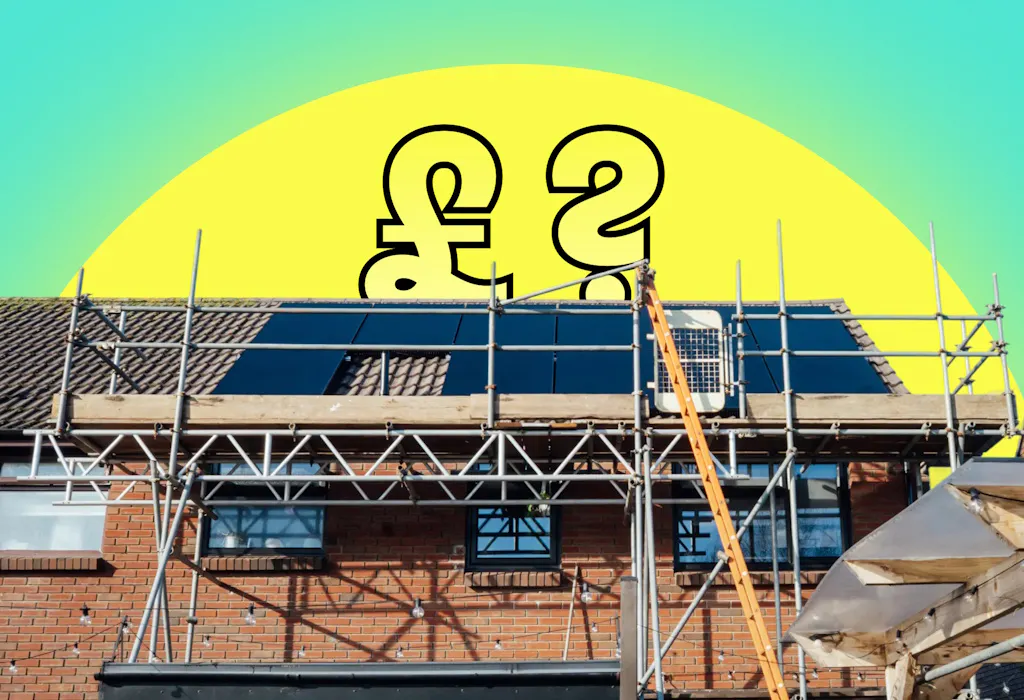
Scaffolding may be unsightly and costly, but for most homes, it’s a crucial step on the way to going solar and reducing your energy bills by hundreds of pounds per year.
You’ll typically pay £700-£2,000, which makes scaffolding one of the most expensive parts of your solar installation – but it’s worth it.
In this guide, we’ll run through everything you need to know, including why scaffolding’s usually necessary, what affects the price, and how long it should stay up for.
If you’re wondering how much you could save with a solar & battery system, enter a few details below and we’ll provide an estimate.
Find out how much you can save
What kind of home do you live in?
Do you need scaffolding to install solar panels?
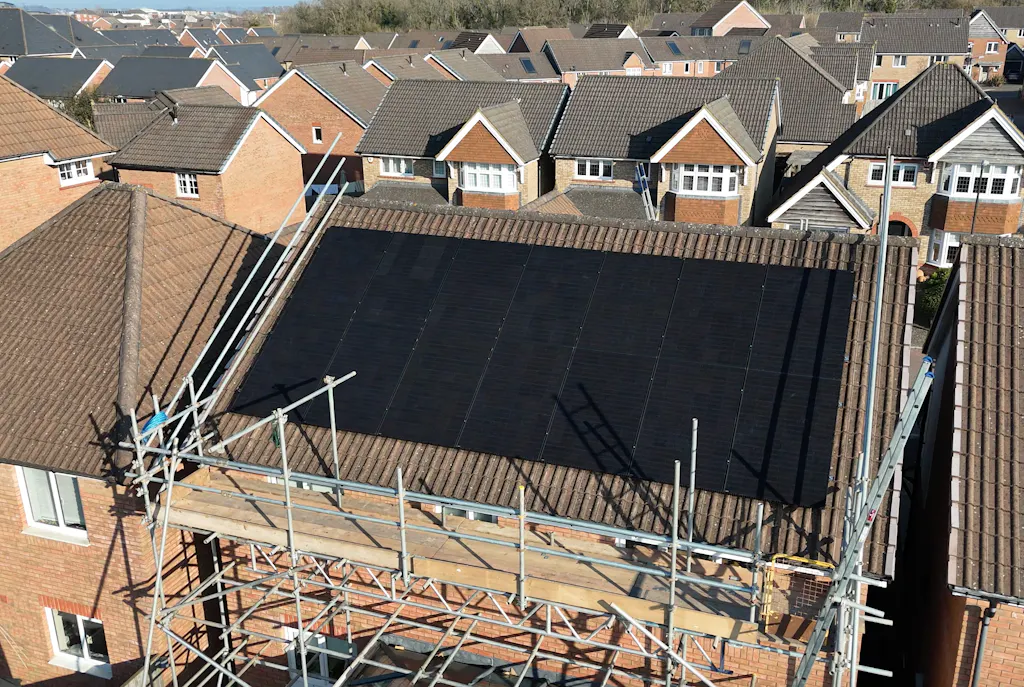
All rooftop solar installations in the UK need scaffolding or an equivalent structure, as it’s a legal obligation to protect workers from injury.
Under the UK government’s Work at Height Regulations, any place of work that’s elevated must be strong, stable, and solid enough to keep workers safe as they move around.
The particulars are left up to individual companies, but across the industry, ladders are viewed as inadequate when it comes to installing solar panels on a roof – and for good reason.
Scaffolding serves two purposes: it keeps the installation team safe from falling, and it protects anyone walking around under the roof – whether it’s workers or you – from being hit by falling tools or equipment.
This should also ensure that your property is left exactly the same as the team found it – apart from your shiny new solar installation, of course.
Ladders can’t offer any of these assurances, so the general rule is to use scaffolding for solar panels. There’s only one big exception to this convention, which we’ll cover below.
Are there exceptions?
A ground-mounted solar panel system doesn’t need scaffolding, since there are no height-related safety concerns.
Otherwise, a good installer will always insist on scaffolding with edge protection – which can include guardrails, netting, and a raised edge known as a toe board.
This allows installers to get on and off the roof safely, and lowers the chances of any dropped gear falling to the ground.
Even if your home is a single-storey building, as long as it has a pitched roof, it’ll be much safer to get scaffolding.
The damage caused by any falling workers or equipment may be lower, but the risk is still too high. After all, even low roofs get slippery in the rain.
How much does scaffolding for solar panels cost?
Scaffolding for solar panels typically costs between £700 and £2,000, depending on the complexity of the installation.
This is just a rough guide, though – you should contact installers to get a better idea of how much it’ll cost you.
Scaffolding tends to be one of the most expensive parts of a solar panel installation, together with labour.
It will be included in your solar quote though, so at least it won’t come as a surprise.
To learn more, check out our guide to solar panel costs.
And if you’re wondering how much you could save with a solar & battery system, enter a few details below and we’ll provide an estimate.
Find out how much you can save
What kind of home do you live in?
What affects the cost of solar panel scaffolding?
There are a few key factors that determine how much your scaffolding will cost:
- The height and width of your property
- How many roof sides need to be accessed
- How accessible your property is
- How complex your roof is
Here’s some more detail on all of these elements.
1. The height and width of your property
The taller your property, the more platforms (known as ‘scaffold lifts’) your installer will need.
They’ll also require more materials and labour to get everything set up, which adds to the cost.
And the higher the scaffolding has to go, the wider it’ll be too.
The traditional three-to-one principle holds that any scaffolding should be a maximum of three times as high as it is wide – though a good installer will go beyond this rule of thumb and assess your home’s specific needs.
And in a similar fashion, the wider your home is, the more scaffolding material will be needed.
2. How many roof sides need to be accessed
If your solar panels are going on your front and back roofs, your installer may need to erect scaffolding on both sides.
This is usually because the elevation at the rear of your property is different to the front, meaning one set of scaffolding can’t travel all the way around your home.
And if you have a terraced home, you’ll need more than one lot of scaffolding to get solar panels on both sides of your roof.
If you need two sets of scaffolding, this will roughly double the cost – though thankfully, many installations only require one.
3. How accessible your property is
If your installer can’t easily get around your property – perhaps because neighbouring buildings are in the way – this can increase the labour time and cost, which is factored into your scaffolding price.
Ideally, you’d have a large driveway and broad side passages. If you have neither, or if they’re both limited in size, this can impact what you pay.
If there’s no way to get scaffolding to the rear of your property other than going through your home, you’ll usually have to pay a ‘carry through’ charge, as a kind of insurance for the firm.
This is mostly seen in mid-terrace homes with no access road behind the garden.
In some urban areas, the best solution is to erect scaffolding on a public footpath. Your installer might need a pavement licence – which tends to cost a few hundred pounds – but it depends on your local authority and how much disruption the scaffolding would cause.
You may also run into issues if you have a lower roof (most often on an extension), since scaffolding can’t rest on surfaces like this, due to the risk of cracking tiles or even breaking through the structure entirely.
In this case, the scaffolding would have to be ‘bridged’ over the low roof, which could involve the installer securely fixing it to the wall using drill ties.
These fixings can cause damage to the outside of your home, but a good scaffolder will fill in any holes before they leave.
4. How complex your roof is
A simple pitched roof is the easiest, cheapest scenario for scaffolders.
But if your roof has any dormers or chimneys – or if it’s a hipped roof – the team will need to come up with a more complex scaffolding configuration.
And any additional labour will always add to the cost.
How long is scaffolding up for solar panels?
Scaffolding is usually up for somewhere between 10 days and four weeks, depending on the complexity of the job.
The team will usually erect your scaffolding around four to five days before the installation, and it should only take about half a day.
Once the installation is done, your installers will leave the scaffolding for a bit, so they can easily address any minor issues that pop up without having to erect it all over again.
This period usually lasts about five days, though some companies prefer to play it safe and leave it up for one or two weeks.
Throughout this process, you should have to do very little. If you can ensure there are no obstructions to erecting the scaffolding – such as bins, garden furniture, or parked cars – your installation team should be happy.
Don’t worry about it too much, though: if anything specific needs to be moved, your installer should tell you well in advance.
And if the job requires a pavement licence, your installer should discuss it with you, then handle the application to the local authority themselves.
Will solar panel scaffolding damage your property?
Solar panel scaffolding shouldn’t cause any permanent damage if it’s carried out by a competent firm.
Just make sure your belongings – like garden furniture and cars – are nowhere near the scaffolding, and your property should emerge completely unscathed.
As mentioned earlier, any holes drilled into your home’s external walls should be made good before the scaffolders leave.
To ensure you hire a professional team, check a solar installer’s reviews before you hire them, so you can see what experiences other customers have had. If you’re unsure about who to choose, our guide to the best solar installers should be useful.
Can you organise your own scaffolding?
If you want to organise your own scaffolding, most solar installers will accept this, as long as they receive guarantees that it’ll fit their requirements.
Perhaps you can get a better scaffolding price from a local firm, or maybe you’ve already decided to get a different home improvement that’ll also require scaffolding.
Whether that job takes place before or after you get solar panels, using one set for both measures can substantially reduce your scaffolding costs.
There is a significant downside, though: if anything goes wrong – like a leak, broken tile, or structural damage to the property – the scaffolders and installation team may end up blaming each other.
It’d be on you to sort it out and get the issue fixed.
Next steps
Scaffolding is a necessary part of every rooftop solar installation, and will usually make up around £700-£2,000 of the total cost, depending on the nature of your home.
While it may cause some disruption for a few weeks, it’ll help your installation team stay safe and protect your property – as long as you keep any vehicles or other belongings well clear.
And it’s a step along the way to going solar, which can save you hundreds of pounds per year on your energy bills, and even increase your home’s value.
If you’re wondering how much you could save with a solar & battery system, enter a few details below and we’ll provide an estimate.
Find out how much you can save
What kind of home do you live in?
FAQs
Related articles

 Josh Jackman
 Josh Jackman
 Josh Jackman
 Josh Jackman
Written byJosh Jackman
Josh has written about the rapid rise of home solar for the past seven years. His data-driven work has been featured in United Nations and World Health Organisation documents, as well as publications including The Eco Experts, Financial Times, The Independent, The Telegraph, The Times, and The Sun. Josh has also been interviewed as a renewables expert on BBC One’s Rip-Off Britain, ITV1’s Tonight show, and BBC Radio 4 and 5.