- Solar advice hub
- Batteries
- AC-coupled batteries: are they worth it?
AC-coupled batteries: are they worth it?
If you’re buying a standalone battery or adding a battery to your solar array, get an AC-coupled model – but a DC-coupled machine is better for a new solar & battery system.


Why you can trust our content
We know that the solar industry is full of misinformation, but we only use reliable sources, including:
- Our experienced solar experts, installers and system designers
- Our own database of solar & battery system designs
- Authoritative bodies like MCS and the UK government



Calculate savings
What kind of home do you live in?


Calculate savings
What kind of home do you live in?
AC-coupled batteries: at a glance
Whether you get an AC-coupled or DC-coupled battery can substantially impact how much money you save on your energy bills – but it’s always hard to tell what’s best for your home.
So we’ll simplify things: if you’re getting a standalone battery or adding a battery to your solar panel system, you should pick an AC-coupled model.
And if you’re having a solar & battery system installed, go for a DC-coupled machine.
In any case, a battery can massively boost your savings, which is probably why about 94% of new solar panel installations in the UK include one, according to data from Flexi-Orb and EPVS.
To find out how much you could save with a solar & battery system, enter a few details below and we’ll provide an estimate.
Find out how much you can save
What kind of home do you live in?
What is an AC-coupled battery?
An AC-coupled battery sits between your inverter and your fuse board in your home’s electricity network.
The term ‘AC-coupled’ just refers to how a battery is connected within a system. It’s wired directly into your home, which uses Alternating Current (AC) electricity – so it’s AC-coupled.
The main difference between the two types of electricity is that AC moves back and forth, while DC only travels in one direction.
AC also doesn’t lose as much power over long distances, making it more efficient. That’s why the grid uses AC, which means your home does too.
However, solar panels produce DC electricity, and your battery – just like those in your phone and laptop – can only run on DC. This is the case whether it’s AC-coupled or DC-coupled.
To ensure your home, phone, and laptop all get the types of electricity they need, you need devices that can convert DC power into AC, and vice versa.
Your phone and laptop chargers do that automatically, and for the rest of your household, you’ll have a solar inverter.
AC-coupled vs DC-coupled batteries
DC-coupled batteries connect directly to your solar panels, so all the electricity your system generates will always go straight to your battery, without having to be converted first.
This means solar electricity only ever has to be converted from DC to AC once, when your battery discharges it to your home or the grid. This is unlike AC-coupled systems, which often involves the same electricity being converted three times (more on this below).
You’ll almost certainly get a DC-coupled battery if you switch to solar in the UK, as an AC-coupled model would make far less sense.
As ever, how your battery is coupled just refers to where it fits into your home’s network, rather than what kind of electricity it uses.
Which is more efficient?
DC-coupled batteries are more efficient, meaning less electricity is lost while storing and converting it, before it’s sent to either your home or the grid.
This is mainly the case because a battery can only store DC electricity, which your solar panels produce.
If the battery receives that electricity straight from your panels, your system will only ever need to convert solar electricity once: when your battery discharges to your home or the grid.
In contrast, if you add an AC-coupled battery to an existing solar panel system, your solar inverter will instantly convert DC to AC power, before feeding it to your home or the grid.
If at any point you have enough solar electricity to run your home, your battery inverter will convert the excess energy from AC to DC, to be stored – and when that power is discharged to your home or the grid, it’ll need to be converted again, from DC to AC.
That’s three conversions – and every time your inverter performs a conversion, around 2% to 5% of that electricity is lost in the form of heat, depending on the model. So the fewer conversions, the more efficient the system is.
An example
In an AC-coupled setup, if your inverter is 96% efficient at every stage, these extra conversions add up to an overall efficiency of 88%. Whereas in a DC-coupled setup, you’ll retain 96% of the solar electricity your panels produce.
However, that difference of eight percentage points only applies to electricity that travels through your battery. Any solar electricity that goes straight to your home will only undergo one conversion, whatever your setup.
If 50% of your solar electricity goes to your battery, and the other 50% goes directly to your home, a typical AC-coupled system will end up with a round-trip efficiency of 92%, compared to a DC-coupled network’s 96% rating.
It’s still a four-point gap though, and over a battery’s lifespan of 10-12 years, this can make a huge difference to your solar returns.
A DC-coupled battery is therefore the better choice, all things being equal – but adding one to an existing solar panel system is more expensive (as we explain below).
If you’re wondering how much you could save with a solar & battery system, enter a few details below and we’ll provide an estimate.
Find out how much you can save
What kind of home do you live in?
When are AC-coupled batteries necessary?
There are three key scenarios when it makes more sense to get an AC-coupled battery:
- If you’re adding a battery to an existing solar panel system
- If you want a battery without solar panels
- If you want whole-home backup for power cuts
Here’s some more detail on each of these situations.
1. If you’re adding a battery to an existing solar panel system
If your solar panels were installed without a battery – which was common a few years ago when batteries were much more expensive – you may well want to add one now.
In this case, an AC-coupled model is your best option.
This is because pre-2020 installations almost all use a standard string inverter that can’t connect a battery to your panels (the DC side of the system).
The string inverter is able to convert the panels’ DC electricity to AC power for your home, but it has no way to communicate with or connect to a battery, so DC-coupling with it is impossible.
On the other hand, an AC-coupled battery can simply slot in on the other side of the inverter, and receive some of the AC electricity that your inverter sends to your home.
The existing string inverter will continue as normal, as it’ll view your battery as just another energy-intensive appliance on your home’s network.
It won’t know your battery is storing the electricity it sends, and it doesn’t need to. Your battery’s inverter can charge and discharge as instructed, completely independently of the solar inverter.
You could add a DC-coupled battery to the system instead, but that would require replacing your string inverter with a hybrid inverter – which usually costs around £1,000-£2,000, plus labour.
What if your string inverter is old?
There is one situation in which you should consider getting a DC-coupled battery for your existing solar panel system.
If your string inverter is reaching the end of its lifespan – and 34% of inverters fail by year 15, according to a 2023 Bern University of Applied Sciences study – you should consider replacing it with a hybrid inverter.
This would allow you to get a DC-coupled battery, and enjoy a more efficient, productive system.
2. If you want a battery without solar panels
It’s increasingly popular in the UK to get battery storage without solar panels.
This is possible – and profitable – due to the falling cost of batteries and the rise of time-of-use tariffs.
You can now charge your battery overnight on cheap, off-peak grid electricity, then use that to cover most – or often, all – of your usage for the rest of the day.
With a tariff like Good Energy Heat Pump, the average household could be paying 14p per kilowatt-hour (kWh) for the vast majority of its electricity – which is much lower than the April 2026 price cap rate of 24.67p per kWh.
You can also sign up to a virtual power plant, which allows you to earn extra income by accessing the energy wholesale markets with other battery owners.
If you go down this path, your battery will be AC-coupled. The whole point of a DC-coupled battery is to connect it to your solar panels’ DC output, before the inverter – so without panels, there’s no reason to get one.
With no DC electricity in your home network, an AC-coupled battery can connect directly to your fuse board, and import cheap grid electricity that lowers your bills in a simple, efficient way.
Rather than performing electricity conversions as it would in a solar setup, your battery inverter will simply govern how quickly you can charge up from the grid.
3. If you want whole-home backup for power cuts
Some batteries can provide you with home battery backup, so that in a power outage, you could keep the electricity flowing to some (or all) of your home.
However, this is a recent phenomenon – so if you got a battery installed a few years ago, it probably won’t have this function.
If you decide you still need backup power, and don’t mind getting a new battery to supply it, adding an AC-coupled model to your existing system is the best way forward.
This new battery will act as a separate store of electricity to be used only in power outages, while your DC-coupled battery continues to carry out its daily bill-cutting duties.
For more information, read our guide to home battery backup for power cuts.
At Sunsave, we install batteries that can provide backup power. If you’re wondering how much you could save with a solar & battery system, enter a few details below and we’ll provide an estimate.
Find out how much you can save
What kind of home do you live in?
The best AC-coupled batteries in the UK
Here are the best AC-coupled battery options in the country, whether you’re adding one to your existing system, or looking for a standalone battery.
This list is in no particular order – all the batteries mentioned are top-tier options that would likely perform well in your home.
Some of them are called ‘all-in-one’ models, which just means the battery and inverter are in the same unit, as outlined earlier. This is an inherently AC-coupled concept, so every all-in-one battery is – by definition – AC-coupled.
GivEnergy batteries used to feature in many lists like these, but unfortunately the Staffordshire-based company went into administration in April 2026.
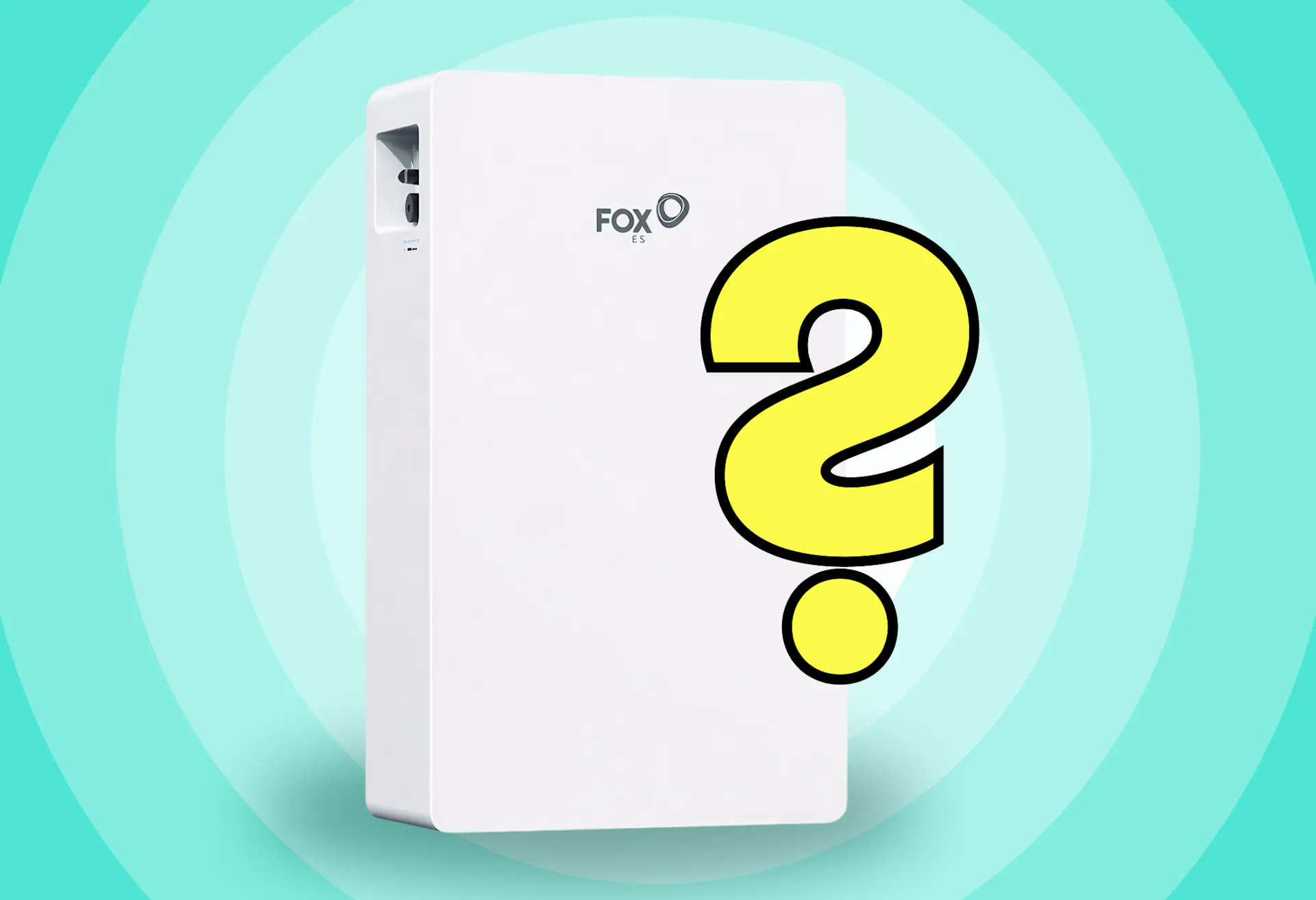
Fox ESS EP12
The EP12 has a hefty capacity of 11.52 kilowatts (kW), and its charge/discharge rate is capable of equalling this if you get the right inverter, meaning you can fill your battery or use all of its power in just one hour.
This allows you to run a number of energy-intensive appliances at once, and puts you in a great position to take full advantage of time-of-use tariffs.
Even if you only have a limited off-peak period, you should be able to quickly charge your entire battery with cheap electricity.
At just 0.45m², this small white box is a lean, mean machine.
Tesla Powerwall 3
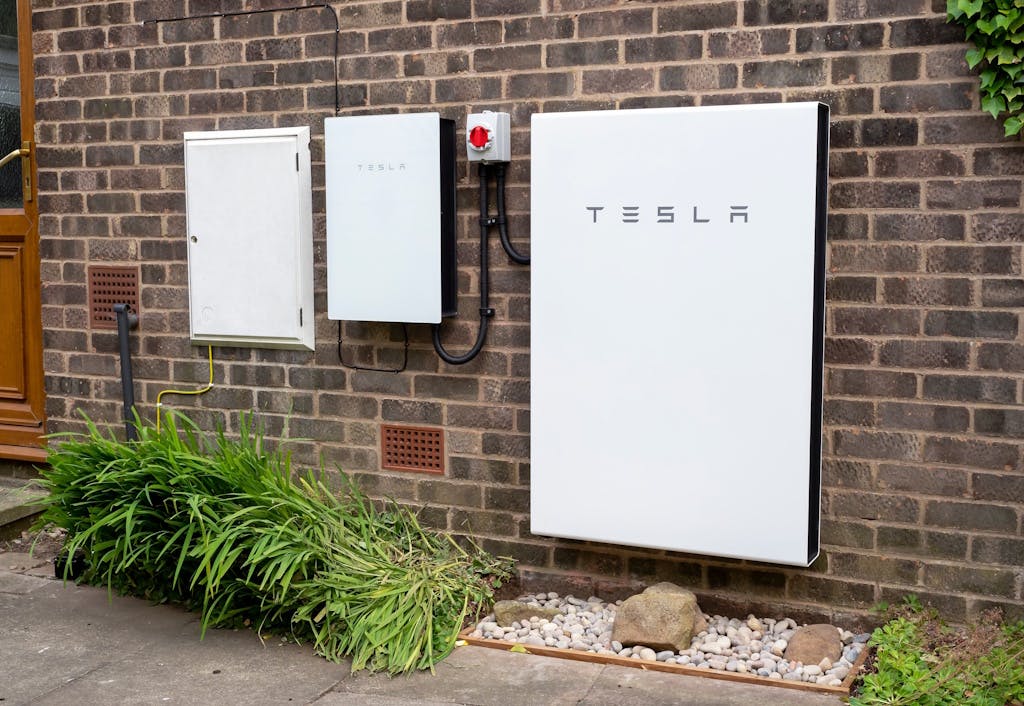
The 2024 edition of Tesla’s flagship battery is mainly marketed as a DC-coupled model, but can be AC-coupled if you’re adding it to an existing system.
This sleek machine comes with a powerful inverter that can provide 11.04kW at once, allowing you to – for instance – charge your electric car and use a kettle at the same time, all on battery power.
The Powerwall 3 is large, with a 13.5kWh capacity that can take another three models and four expansion units, if you fancy having 94.5kWh of battery storage.
It also comes with a 10-year warranty that promises the battery will retain 80% of its original capacity with no cycle limit, which is a massive vote of confidence from the company.
For more information, check out our guide to the Tesla Powerwall.
Enphase IQ Battery 5P
This stylish silver 5kWh battery can seem a bit lightweight – and it is lighter than most – but it’s extremely scalable.
Customers are able to fit as many as 14 of these modules, for a total usable capacity of 66.5kWh.
It can fully charge and discharge in just 1.5 hours, and comes with a generous warranty that’s much longer than the industry average, which we’ve calculated is around 10.7 years.
You’ll be covered for 15 years or 6,000 cycles, whichever comes first – and if you cycle your battery once per day, you’ll reach 15 years first.
Sigenergy Sigen Battery
This 6kW battery comes with a 100% Depth of Discharge, which means that like the Tesla Powerwall 3, you can use its full capacity.
And it’s light for a high-grade battery, at just 62kg – roughly 20kg less than the industry average.
Sigenergy’s 10-year warranty is reasonable, and its expected lifespan of 10,000 cycles should – in theory – enable you to run it twice per day for more than 13 years.
With a 3kW discharge rate, it’s not the quickest model around, but you can still charge it to full in two hours – which should be more than enough time to fill it with off-peak electricity.
Is an AC-coupled battery worth it?
An AC-coupled battery almost always significantly increases the savings you can make with a solar panel system, so it’s usually worth the investment.
Without a battery, you’ll typically export a large chunk of your solar electricity every day, at export rates that range from around 3-15p per kWh – then buy that electricity back from the grid in the evening, for around 24p per kWh.
Adding a battery, even if it is AC-coupled, lets you store all the electricity your panels generate during the day, then use it in the evening to replace grid electricity.
It also allows you to access time-of-use tariffs – like Good Energy Heat Pump – and virtual power plants, all of which can further increase your savings.
And if you're just looking to get battery storage without solar panels, an AC-coupled model is your best bet.
If you’re wondering how much you could save with a solar & battery system, enter a few details below and we’ll provide an estimate.
Find out how much you can save
What kind of home do you live in?
AC-coupled batteries: FAQs
Related articles
 Josh Jackman
 Josh Jackman
 Josh Jackman
 Josh Jackman
Written byJosh Jackman
Josh has written about the rapid rise of home solar for the past seven years. His data-driven work has been featured in United Nations and World Health Organisation documents, as well as publications including The Eco Experts, Financial Times, The Independent, The Telegraph, The Times, and The Sun. Josh has also been interviewed as a renewables expert on BBC One’s Rip-Off Britain, ITV1’s Tonight show, and BBC Radio 4 and 5.