- Solar advice hub
- Solar-technology
- Plug-in solar panels: are they worth it?
Plug-in solar panels: are they worth it?
You may be able to self-install plug-in solar panels in the UK soon – but not yet. Here's everything you need to know.


Why you can trust our content
We know that the solar industry is full of misinformation, but we only use reliable sources, including:
- Our experienced solar experts, installers and system designers
- Our own database of solar & battery system designs
- Authoritative bodies like MCS and the UK government



Calculate savings
What kind of home do you live in?


Calculate savings
What kind of home do you live in?
Plug-in solar panels: at a glance
On 24 March 2026, the UK government announced that domestic plug-in solar panels would be available to buy and self-install “within months”.
Then on 17 July, the government passed legislation making that possible, which is set to come into force on 27 August.
When that moment comes, it could allow millions more households, and in particular flats with a balcony, to reduce their energy bills by generating solar electricity.
In this guide, we’ll give you the latest on when these changes will come into force, whether plug-in solar panels are worth waiting for, and which homes should (and shouldn’t) get a system.
Plug-in solar panels aren’t available yet, but traditional solar & battery systems are a proven and popular way of significantly cutting energy bills, with more than 1.6 million homes having already made the move.
If you own your property and live in a house, traditional rooftop solar offers far better savings. To find out how much you can save with a solar & battery system, pop a few details below and we’ll provide an estimate.
Find out how much you can save
What kind of home do you live in?
What are plug-in solar panels?
Plug-in solar panels, also known as ‘plug and play’ solar panels, can be self-installed and plugged directly into a mains socket – like most other electrical devices.
This allows households to reduce their energy bills by generating free solar electricity, all without having to pay an installer.
These systems are especially good for people who can’t get rooftop solar – perhaps because they live in a flat or rented accommodation – but have a balcony or garden they can use.
They're banned here, though. The government has said that "solar plug-in microgenerators [i.e. panels] cannot be legally sold, supplied, or used in the UK due to constraints arising from existing product safety legislation".
This legislation exists because plug-in solar panels have significant safety concerns in the UK. More on this below.
Plug-in solar is already a common sight in Europe, particularly in Germany.
More than 1.5 million households in Germany have installed their own systems, with around 500,000 new devices installed per year.
What does a plug-in solar panel kit include?
A standard plug-in solar kit includes two panels, each with a peak capacity of 400-450 watts (W).
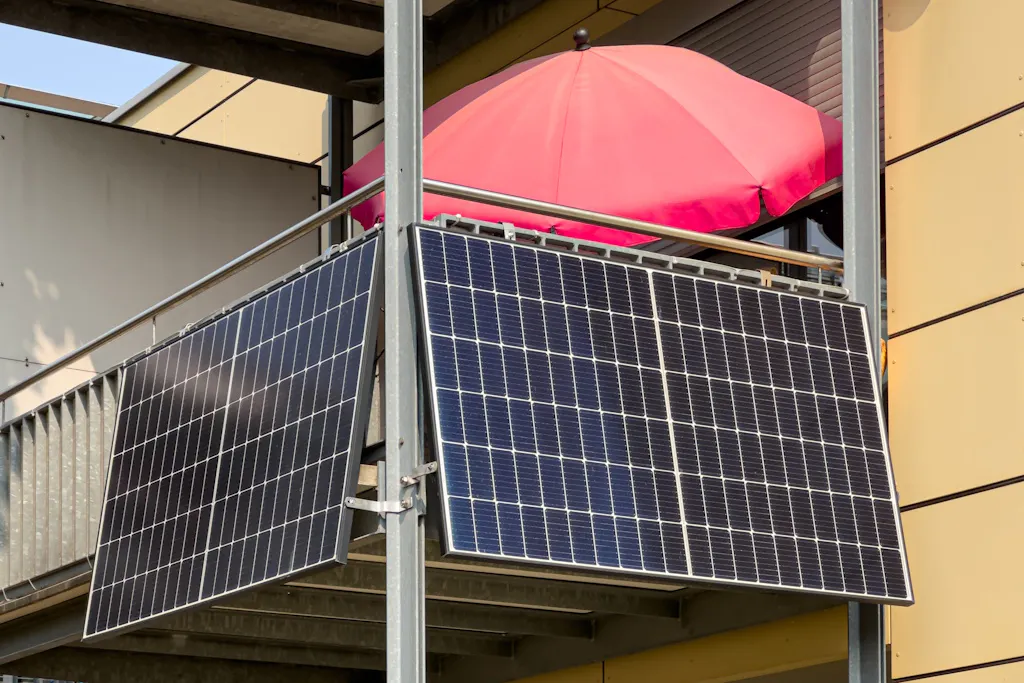
These monocrystalline panels are around 22-25% efficient, which is just as good as regular rooftop panels, with the same sleek, black, modern look – but they're lighter, so they can be safely hung on balconies or walls.
Unfortunately, they likely won't receive as much light on your balcony as they would on your roof, and will therefore produce less electricity.
When you're buying a package, you'll be able to choose between different types of metal brackets, depending on whether you’re putting the panels on a balcony, in your garden, or on a wall.
The kit will also include an installation guide, safety instructions, and an 800W microinverter (more on this further down). Once the regulations change, this microinverter will be safe to plug into a standard three-pin socket, with no extra electrical work.
When will plug-in solar panels be available in the UK?
Plug-in solar panels will be available for UK households to buy and install in August 2026 at the earliest, as the government's new legislation specifies.
Lorna Wallace-Smith of solar manufacturer EcoFlow said in March 2026 that “seeing these systems available in stores by summer would be a major win for households”, which won't happen now.
The government previously told the public that plug-in solar panels "cannot demonstrate compliance” with current regulations, and “therefore cannot be legally placed on the market or used by consumers.”
The regulations in question are the Electricity Safety, Quality and Continuity Regulations 2002 (ESQCR) and the Plugs and Sockets etc. (Safety) Regulations 1994 (PSSR). We'll go into more detail about these rules near the end of the article.
The government has moved to create new guidance, releasing the final version of the Plug-in Solar Device Interim Product Specification in July 2026, which should allow stores to sell these panels.
When they are available, you’ll be able to get plug-in panels from EcoFlow, as well as retailers like Amazon and Lidl. All these companies have worked with the government to bring plug-in solar to the UK.
Are plug-in solar panels safe?
Multiple industry bodies have expressed serious concerns about the safety of installing plug-in solar panels in UK homes.
In March 2026, the Institution of Engineering and Technology (IET) warned households to get their electrics checked by a trained professional before buying plug-in panels.
The IET's Mark Coles said: "Many UK homes have ageing, modified or poorly maintained electrical installations.
"Introducing a generating source into wiring that hasn’t been checked could expose homeowners to risks that are not immediately obvious."
One particularly troubling risk is that the Residual Current Device (RCD) – the safety switch on your fuse board that protects you against electric shocks – doesn't work, as older versions weren't designed for generating devices.
In June 2026, five bodies including the Electrical Contractors’ Association (ECA) made a joint statement saying without proper safety procedures ahead of the plug-in rollout, "there is a serious risk of avoidable hazards in homes".
They said these potential issues included "overheating and fire, as well as creating trip and fall hazards", adding that "a low upfront cost must not override safety".
The government's safety study
However, also in June, the government commissioned a safety study that "supports the conclusion that plug-in PV is compatible with UK domestic electrical systems, and that a controlled deployment framework is both achievable and justified based on the evidence."
Despite this confident conclusion, the study does say the home's safety "depends not only on the characteristics of the device itself, but on the condition of the receiving installation and the behaviour of the consumer.”
And the authors admit they didn't consider "broader building safety and fire safety questions, particularly in multi-occupancy buildings [and] higher risk residential settings”.
This is unfortunate, since people in flats are likely to be the most enthusiastic about getting plug-in solar panels.
Who can get plug-in solar panels?
Once the government has updated the regulations around plug-in solar panels, all households should be able to buy and install these systems themselves.
There are around 285,000 flats with balconies in England alone , whose residents could benefit enormously from this rule change.
And considering more than 80% of households in Britain have a private garden or outside space, most people in the country should have somewhere they can install a plug-in system.
However, plug-in solar panels will probably only be a good idea for people who have otherwise been unable to go solar.
If you own your property and have enough roof space, traditional rooftop solar panels are a much better option (more on this below).
Will renters need landlord permission?
Renters will probably need permission from their landlord to put up plug-in solar panels, but the government has indicated that it'll ensure as many tenants as possible can make the move.
Climate minister Katie White told The i Paper in April 2026 that she doesn't think many landlords will say no, but would consider changing the law if it becomes a source of "friction".
Germany's parliament has already taken this step, by passing a law that gives people who live in rented accommodation – more than half the population – the right to plug-in solar.
Tenants still have to ask their landlord, but this request can only be rejected in exceptional circumstances.
Leaseholders may have to go through a similar process, with the added inconvenience of potentially having to pay extra.
It all depends on your lease agreement, which can include one of a few different permission levels. It may also allow your landlord to charge an administration fee.
To learn more about switching to solar as a leaseholder, read our guide to solar panels for leaseholds.
How do plug-in solar panels work?
A plug-in solar panel system usually consists of two panels that you can hang over your balcony, after securing them in place with brackets or hooks.
You could also put a system on your terrace, patio, garden, or even suspend it on a wall.
Whatever location you choose, just make sure your panels are as unobstructed by shade as possible, to maximise their electricity production.
Each set of plug-in solar panels comes with a microinverter that connects to your panels and plugs into a mains socket. In contrast, most rooftop systems use a standard string inverter.
This does mean you’ll either need a socket outside, or to find a way to feed a wire through your home’s wall, so the microinverter can plug into an inside socket.
Your system will be productive throughout the day, as the photons present in sunlight dislodge electrons in your panels’ silicon atoms, generating Direct Current (DC) electricity.
This electricity flows through your microinverter, which converts it into Alternating Current (AC) electricity and feeds it to your home via the mains socket.
The UK is modelling its approach on the German standard, which sets an 800W AC output limit on the microinverter. A typical German system uses two 400-450W panels and one 800W microinverter.
And in the event of a power cut, your system will automatically shut down. This is called 'anti-islanding', and is a crucial safety feature for engineers working on power lines.
Is your balcony suitable for plug-in solar?
Whether your balcony is suitable depends on a few factors, which can determine whether plug-in solar panels will save you enough money to make them worth it.
Firstly, much like rooftop panels, a plug-in system isn't a good idea in the UK if it has to face north. South is ideal, and east or west are also acceptable.
Your plug-in solar savings will also take a hit if there's any unavoidable shading on your balcony.
This will reduce the output of the affected panel – and since systems comprise two panels sharing one microinverter, any shade on one panel will cut the other one's output as well.
A large building or tree between your panels and the sun could make any solar installation pointless, so make sure you assess your balcony before buying.
For more information, read our full guide to solar panel shading.
What happens to the excess energy?
Just like their rooftop counterparts, plug-in solar panels will sometimes produce more electricity than your home needs – especially in summer.
When this happens, your inverter will send any excess electricity to the grid.
Unfortunately, you won’t be able to sign up for any solar export tariffs, as these require MCS or Flexi-Orb certification – so you won't be paid anything for this exported energy.
This is a serious drawback of plug-in solar panels, since export income is one of the main financial benefits of rooftop solar, netting households hundreds of pounds per year.
However, there is a solution: you can store most of this excess electricity by adding a battery (more on this below).
How much do plug-in solar panels cost?
A standard system with two 400W panels and a microinverter costs around £500.
£500 isn’t cheap, but it’s certainly a lot less than the cost of rooftop panels and a battery, which is around £11,000 for a typical household.
Naturally, the price can change depending on how many panels you get and how powerful they are – though there’s not much point getting more than two 400-450W panels, since your inverter will be capped at 800W.
The location of your panels can also affect the price, as you'll need specialised mounting equipment for different places. Here’s a bit more detail on that.
Location | No. of plug-in solar panels | Rough cost * |
|---|---|---|
90° facade | 2 x 400W | £450 |
Lattice balcony | 2 x 400W | £500 |
Garden | 2 x 400W | £550 |
Glass balcony | 2 x 400W | £600 |
Concrete balcony | 2 x 400W | £650 |
Unfortunately, the 0% VAT rate doesn't apply to plug-in solar panels.
Any solar hardware that you buy or install yourself is excluded – so you'll pay the standard 20% rate.
How much can you save with plug-in solar panels?
You can save more than £100 per year with plug-in solar panels.
A plug-in solar panel is unlikely to produce as much energy as a roof-mounted panel, since all the most common installation locations – a balcony, outside space, or wall – don’t usually come with the optimum angle of 40°.
But EcoFlow has said its standard system, with two 400W panels and a microinverter, “can help you save up to £115 per year on energy costs.”
And the government has told Sunsave that you can reduce your energy bills by up to £70-£110 with plug-in solar panels.
With kits costing about £500, you should break even in roughly five to nine years – and that payback period will shrink if energy bills continue to rise.
These savings could be much higher if you add a battery to your system. Your upfront cost would also rise though, which could extend your break-even period.
Savings with a proper rooftop solar & battery system are significantly better though, so it’s worth considering this instead if you own your home and have a suitable roof (more on this below).
To find out how much you could save with rooftop panels, pop your details below and we'll provide an estimate.


Can you add a plug-in battery?
You can add a plug-in battery to your home, as long as you get a professional electrician to install it on a dedicated circuit.
As with plug-in panels, UK regulations currently prohibit self-installation.
Once they’re set up, these devices can charge from the grid, then power your home when called upon.
This allows you to take advantage of time-of-use (TOU) tariffs, which come with off-peak periods that let you charge your battery up with cheap electricity every night, then use it in your home.
You can also store any excess solar electricity that your plug-in panels produce, then use it after the sun's gone down.
However, there are significant safety concerns relating to this technology. To learn more, read our full guide to plug-in batteries.
What regulations are changing?
Under current safety regulations, manufacturers and retailers aren't allowed to sell plug-in panels, and customers can't use them.
But the government's planning to change the regulations, which would effectively lift the prohibition on plug-in panels.
First, it intends to amend the Plugs and Sockets etc. (Safety) Regulations 1994, to allow compliant plug-in solar panels to be connected with standard three-pin plugs.
The government also wants to put in place an interim specification for plug-in panels that'll include in-depth installation instructions, to address safety risks during the transitional period.
Additionally, it plans to change the G98 Engineering Recommendation to allow for plug-in panels to be connected in homes, as long as they meet the interim specification.
It also aims to amend the Electrical Safety, Quality and Continuity Regulations 2002 to make sure plug-in solar panels are possible under electrical safety regulations.
And in the long run, the government wants to create permanent product standards and regulations that include plug-in panels.
What are the new rules?
The new rules, contained within the government's Plug-in Solar Device Interim Product Specification document, model the UK's approach on Germany.
Germany discovered that by keeping the inverter’s wattage limit to a low enough level – 800W, currently – the risks are manageable within standard domestic wiring.
It also permits systems of a certain size to connect to household mains without a dedicated circuit, with the safety burden shifted onto the inverter.
Manufacturers must ensure inverters don't push more electricity than wires can handle, include a feature that shuts them down in a power cut (‘anti-islanding’), and guard against plug prongs electrocuting anyone when they’re unplugged.
If these boxes are ticked, households will be able to plug in a microinverter that’s no larger than 800W. Your panels, however, could add up to more than 800W, as installers will usually recommend your inverter be 80% to 90% the size of your system.
Plug-in solar vs rooftop panels
While a plug-in solar panel system could save you more than £100, a typical home with rooftop solar panels and a battery could cut your bills by more than £1,100 per year.
In fact, on average, you could save 94% on your electricity bills with a solar & battery system.
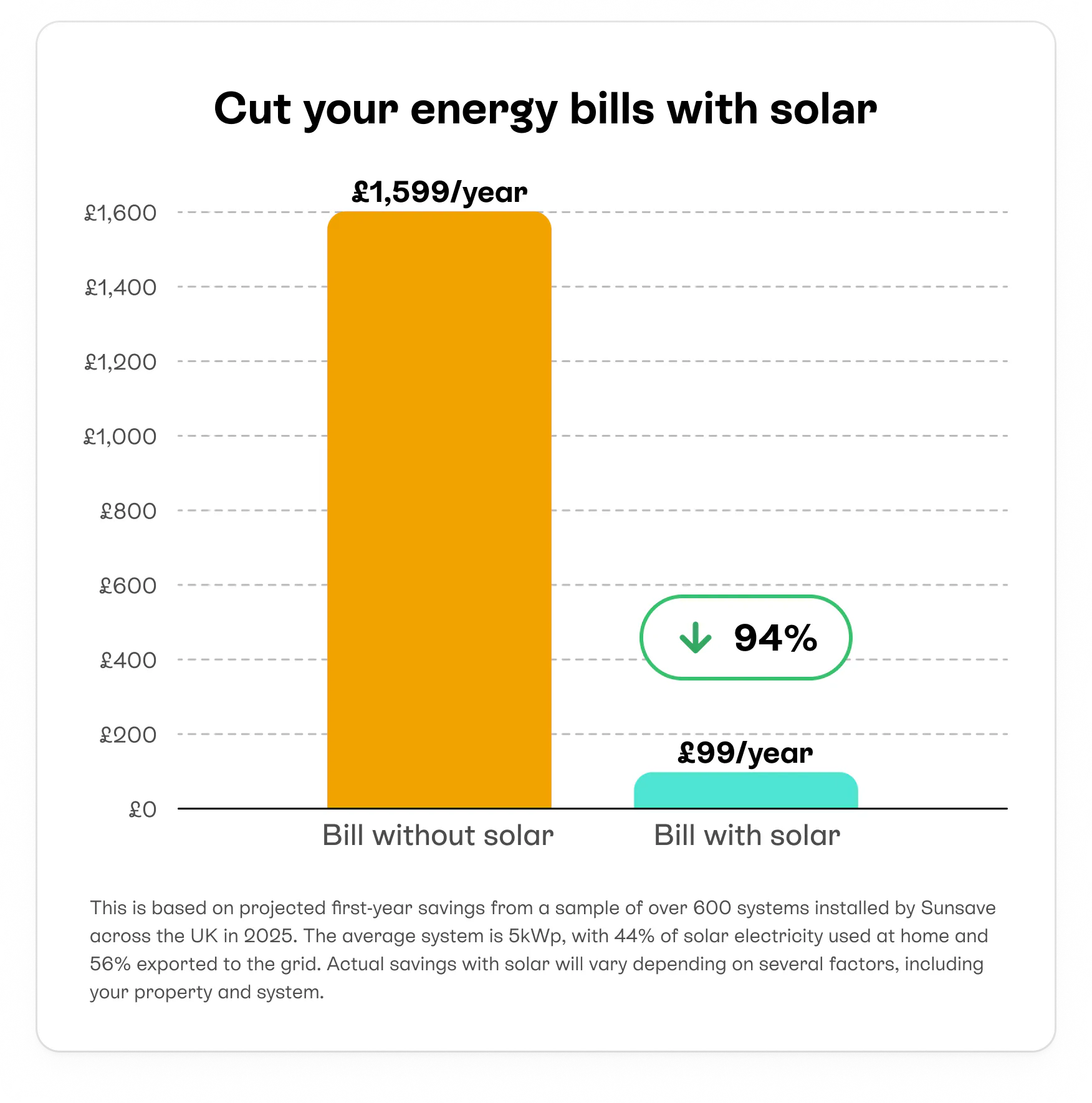
This is based on projected first-year savings from a sample of over 600 systems installed by Sunsave across the UK in 2025.
The average system is 5kWp, with 44% of solar electricity used at home and 56% exported to the grid. Actual savings with solar will vary depending on several factors, including your property and system.
This difference is partly because rooftop systems include many more panels – often between 10 and 12 – rather than just two, and also due to roofs usually offering better conditions for solar production (e.g. a better angle and minimal shade).
A larger system with better-positioned panels means more electricity, which you can use to replace a substantial chunk of the power you buy from the grid.
You can also sell all your excess electricity to the grid by using one of the best export tariffs, which you can’t do with plug-in systems, since they’re not included in the Smart Export Guarantee.
Your battery will help you maximise your returns, especially as you can use it to take advantage of time-of-use tariffs and virtual power plants.
So if you own your property and have suitable roof space – and you can afford it – traditional rooftop panels and a battery are a much better choice than plug-in solar.
If you’re wondering how much you could save with a rooftop solar & battery system, enter a few details below and we’ll provide an estimate.
Find out how much you can save
What kind of home do you live in?
Are plug-in solar panels worth it?
Plug-in solar panels might be a great way for certain homes to cut their electricity bills, once the regulations change.
They’re increasingly popular in Germany, and make sense for anyone who has some outside space and an available nearby socket, can afford the roughly £500 price tag, and can’t currently get rooftop panels.
However, industry experts have raised significant safety concerns relating to plug-in solar panels, which would need to be resolved before we can confidently recommend them to anybody in the UK.
Plug-in solar: FAQs






Related articles

 Josh Jackman
 Josh Jackman
Written byJosh Jackman
Josh has written about the rapid rise of home solar for the past seven years. His data-driven work has been featured in United Nations and World Health Organisation documents, as well as publications including The Eco Experts, Financial Times, The Independent, The Telegraph, The Times, and The Sun. Josh has also been interviewed as a renewables expert on BBC One’s Rip-Off Britain, ITV1’s Tonight show, and BBC Radio 4 and 5.