- Solar advice hub
- How-solar-works
- Solar panels for leasehold homes: explained
Solar panels for leasehold homes: explained
Here's how you can get solar panels installed on your leasehold property, the best way to go about obtaining permission from the freeholder, and how much it can cost.


Why you can trust our content
We know that the solar industry is full of misinformation, but we only use reliable sources, including:
- Our experienced solar experts, installers and system designers
- Our own database of solar & battery system designs
- Authoritative bodies like MCS and the UK government



Calculate savings
What kind of home do you live in?


Calculate savings
What kind of home do you live in?
At a glance
A solar & battery system can benefit the vast majority of UK homeowners. The process is a bit more complicated if you’re a leaseholder, but that doesn't mean switching to solar isn't possible.
In this guide, we’ll explain how you can get solar panels installed on your leasehold property, the best way to go about attaining permission from the freeholder, and how much it can cost.
If you’re not sure of your rights and obligations as a leaseholder, please seek out advice from a specialist solicitor in this area of the law.
And if you’re wondering how much you could save with a solar & battery system, enter a few details below and we’ll provide an estimate.
Find out how much you can save
What kind of home do you live in?
What is a leasehold?
A leasehold gives you ownership over a property for a set period of time – usually 99, 125, or 999 years.
This differs from a freehold, which provides you with permanent, total ownership of a property and the land it’s on.
When you buy a leasehold, you pay the freeholder for the right to live in that home for the length of the lease, unless you extend it before it ends.
A leaseholder can’t be evicted before the end of the lease without a serious breach of their contract, and won’t have to pay rent – though they will probably be charged other fees called ground rent and a service charge.
77% of leaseholders in England pay ground rent, at an average cost of £304 per year (though this is set to be capped at £250 ), while 65% pay a service charge – £2,300 per year, on average.
Between 2016 and 2024, this figure rose by 49% across England and Wales.
How common are leaseholds?
Around 5.08 million homes in England and Wales are leaseholds, meaning they constitute 19% of all housing in England and 16% in Wales.
Leasehold homes are most common in London, at 38% of all households, which is likely due to the unusually high percentage of Londoners who live in flats: 54%, compared to 17% across England.
Traditionally industrial cities like Manchester, Sheffield, and Liverpool top the charts for leasehold houses. As a result, 22% of houses in the North West are leasehold, along with 10% in Yorkshire and the Humber, and 8% in the North East.
Are leasehold homes suitable for solar panels?
28% of leaseholds are houses, which means they’re candidates for solar panels - providing their roof is suitable.
And leaseholds should get gradually less common, as all new builds must now be sold as freehold properties (other than in exceptional circumstances), thanks to the Leasehold and Freehold Reform Act 2024.
However, the majority of leaseholds are flats, including 3.5 million homes (72%) in England and (64%) 151,000 in Wales.
Owning a flat and being a leaseholder almost always go hand in hand across the two countries; 99% of flat sales in 2024 were leasehold.
This can be a barrier towards going solar, though a rooftop installation is a tricky prospect for any flat owner. After all, most apartment blocks have flat roofs, which aren’t ideal for solar.
Plug-in solar panels would be much simpler, and will soon be safe and within electrical regulations. Balcony panels are already popular in France, Germany, and the Netherlands.
Plug-in batteries are also available to buy, though current UK guidelines require them to be installed by a trained electrician.
We’ll discuss lower down how a leaseholder can go about switching to solar.
Can you install solar panels on a leasehold property?
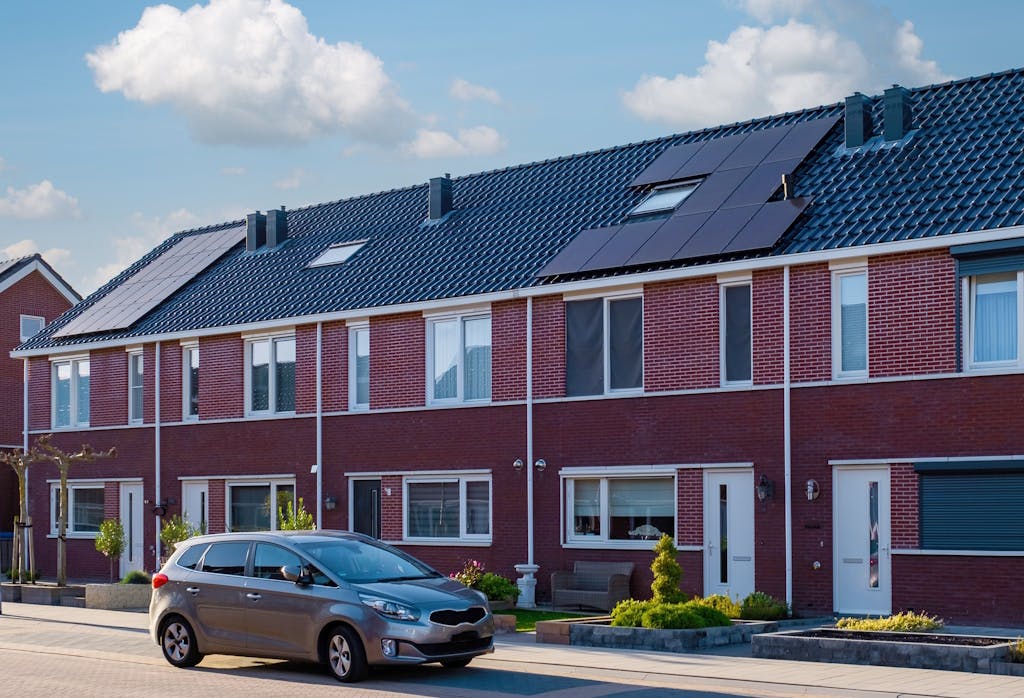
You may well be able to get solar panels installed on the roof of a leasehold property.
Read through your lease agreement first to check, and if you’re still not sure about your rights and responsibilities, get specialist legal advice before moving forward.
Leaseholders who can go solar usually need to get permission from their freeholder first, as the roof tends to be defined as a common area in most agreements – which puts it under the freeholder’s control.
If your freeholder pays for legal advice or a surveyor while deciding whether they should accept your proposal, you may have to refund them for any reasonable expenses.
Getting permission from the freeholder
Leaseholders need to get permission from their freeholder before getting solar panels, in the form of a licence for alterations (also known as a licence to alter).
How difficult it is to secure this written legal agreement will depend on your alterations covenant.
Every lease contract contains an alterations covenant. In England and Wales, this will generally take on one of three forms: fully qualified, qualified, or absolute.
A fully qualified covenant is the best type for leaseholders, as it means a freeholder can only withhold consent with good reason.
A qualified covenant isn’t as generous, as it allows the freeholder to reject a proposal – or accept it with conditions – but in accordance with the Landlord and Tenant Act 1927, “consent is not to be unreasonably withheld”.
Most residential long lease agreements include one of these two covenants, meaning most leaseholders could feasibly get permission to install solar panels.
This isn’t the case with an absolute covenant, though. This clause restricts leaseholders from carrying out any works on their property, with very little wiggle room.
However, absolute covenants are more commonly found in lease agreements for apartment buildings – where it’s already difficult to go solar – rather than for houses.
If you’re not sure which covenant applies to your lease, some surveyors offer free contract assessments.


Does it cost money to get freeholder consent?
It may cost you money to get freeholder consent, as they’re entitled to ask for an administration charge.
This charge can be a flat fee that applies regardless of the size of your works or any fees the freeholder pays along the way, or it can match your freeholder’s expenses exactly.
If it’s the second option, you’ll need to cover any costs they incur from paying a legal firm or surveyor to assess and advise on your works, within reason.
A solar installation may not require much legal advice, but it’s relatively likely that your leaseholder will hire a surveyor to look over your plans.
They may charge you more if their surveyor carries out multiple inspections, or if the property is a listed building or in a conservation area.
However, the freeholder must clearly lay out the rights and obligations that accompany the administration charge, or you don’t have to pay.
This is spelled out in the Commonhold and Leasehold Reform Act 2002, which also explains that you can challenge the fee.
It states: “You have the right to ask a leasehold valuation tribunal whether an administration charge is payable. You may make a request before or after you have paid the administration charge.”
What if your council is the freeholder?
If your local authority is the freeholder, you’ll have to apply for permission to get rooftop solar panels.
Fortunately, many authorities welcome these applications. They often have net zero targets, and residents going solar by themselves is a step towards this goal – while costing them nothing.
However, to be granted permission, you must own the part of the roof you’re looking to put panels on. If it’s not included in your lease agreement, the council will reject your application.
The local authority will also assess your plan based on how it affects your neighbours, maintenance, future works, health and safety, legislative requirements, and the appearance of the building.
If the installation could inconvenience other residents (e.g. if you live in a block of flats), your council may ask them for their views. Any objections could harm your chances, so talk to your neighbours before applying.
You’ll have to pay an application fee, though the amount varies. For example, Cambridge City Council charges £30, while people in Tower Hamlets have to pay £279.
The council will usually make its decision within a matter of weeks, not months. Cambridge City Council says on its site: “We aim to respond to applications in full within two weeks. Applications that require a visit can take up to six weeks”.
And Lambeth Council says: “It takes between 15 working days and four weeks to get a decision on your application.”
If you’re successful, the council will give you its conditional consent. This will usually require you to use a competent tradesperson, and ensure the installation meets the standards of any surveyor the council sends to inspect it.
Make sure you submit an application in advance, since asking for permission once the installation is complete can cost hundreds or even thousands of pounds extra.
Summary
It’s completely possible for leaseholders to go solar.
As long as your lease agreement contains a qualified or fully qualified alterations covenant, you’ll be able to move ahead with permission from your freeholder.
Getting this consent will probably cost some money, take at least a few weeks, and involve jumping through several hoops – but it may well be worth it.
After all, switching to solar can cut your energy bills by hundreds of pounds per year, protect you against future energy price rises, and increase your home’s value.
If you’re wondering how much you could save with a solar & battery system, enter a few details below and we’ll provide an estimate.
Find out how much you can save
What kind of home do you live in?
FAQs



Related articles

 Melody Abeni
 Charlie Clissitt

 Josh Jackman
Written byJosh Jackman
Josh has written about the rapid rise of home solar for the past seven years. His data-driven work has been featured in United Nations and World Health Organisation documents, as well as publications including The Eco Experts, Financial Times, The Independent, The Telegraph, The Times, and The Sun. Josh has also been interviewed as a renewables expert on BBC One’s Rip-Off Britain, ITV1’s Tonight show, and BBC Radio 4 and 5.