- Solar advice hub
- Installation
- Solar panels for flats: explained
Solar panels for flats: explained
There are four main ways to get solar panels if you live in a flat, including plug-in solar and shared systems. Here's everything you need to know.


Why you can trust our content
We know that the solar industry is full of misinformation, but we only use reliable sources, including:
- Our experienced solar experts, installers and system designers
- Our own database of solar & battery system designs
- Authoritative bodies like MCS and the UK government



Calculate savings
What kind of home do you live in?


Calculate savings
What kind of home do you live in?
Solar panels for flats: at a glance
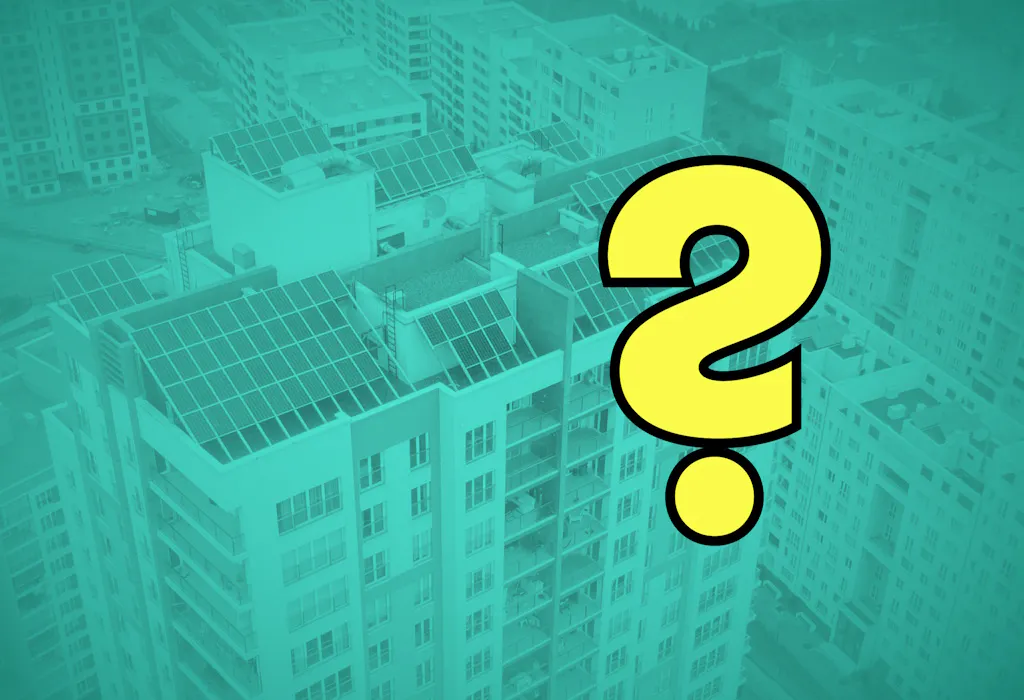
5.4 million UK households live in flats – 21.7% of all households – and they should be able to benefit from cheap, renewable electricity in the same way as people in houses.
Fortunately, balcony solar panels should soon be a profitable prospect for certain people in flats – and it’s worth considering standalone batteries, too.
In this guide, we’ll explain how feasible it is to get solar panels in a flat, the new regulations around plug-in solar panels, and what you can do if you’re renting or a leaseholder.
We don’t install solar panels for flats, but if you have a house and want to find out how much you could save with a solar & battery system, enter a few details below and we'll provide an estimate.
Find out how much you can save
What kind of home do you live in?
Can people in flats get solar panels?
People in flats can switch to solar, but it’s more complicated than it is for house owners.
Anyone with a detached house has the easiest route to getting solar panels, followed by semi-detached property owners.
One complicating factor is that many people who live in flats are renting, so beyond plug-in solar panels, they can’t simply decide to switch to solar. That choice is up to the landlord, not the tenants.
And even people who own flats mostly have leasehold agreements, rather than freehold contracts.
It’s not even close: 99% of flat sales in 2024 were leaseholds, according to a parliamentary research briefing that also said: “Leasehold is the default tenure for privately owned flats in England and Wales.”
These flat owners all require the freeholder’s permission to get rooftop solar panels, and while this is achievable in many cases, it presents another obstacle.
For more information, read our guide to solar panels for leasehold homes.
How many flats have solar panels in the UK?
11.7% of residential rooftop solar installations in the UK are on flats, according to the latest MCS data.
That means just 193,173 of the UK’s 1.65 million domestic systems have been installed on flats.
Considering 21.7% of households (or 5.4 million) live in a flat , this represents a clear under-representation of flats in UK domestic solar installations.
In contrast, detached houses are significantly over-represented: they make up 23.2% of all homes , but 36.2% of solar households.
Just 1.8% of London households have switched to solar, the lowest of any UK region. This is almost entirely down to the fact that flats make up a staggering 54% of housing stock in the capital.
Unsurprisingly, London is home to every single one of the top 10 local authorities with the lowest percentage of households with solar installations in the UK.
There’s also relatively little space between buildings in London, making it harder for installers to erect scaffolding, while the height of many apartment blocks makes the prospect of getting scaffolding far too expensive.
How to get solar panels if you live in a flat
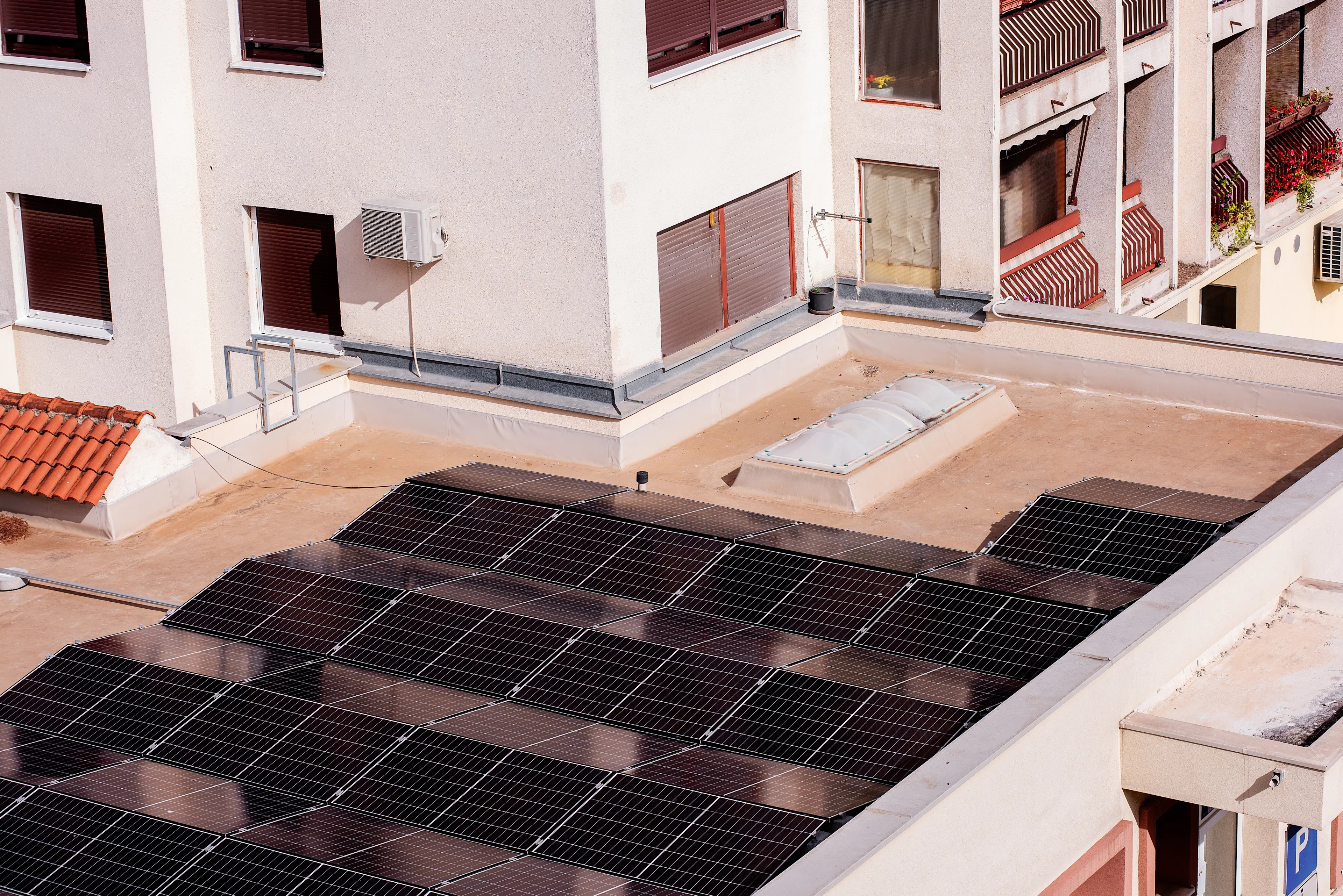
There are only four possible ways for people in flats to switch to solar:
- Balcony solar panels
- Private rooftop systems
- Shared rooftop systems
- The local authority intervening
Here’s a bit more detail on each one.
1. Balcony solar panels
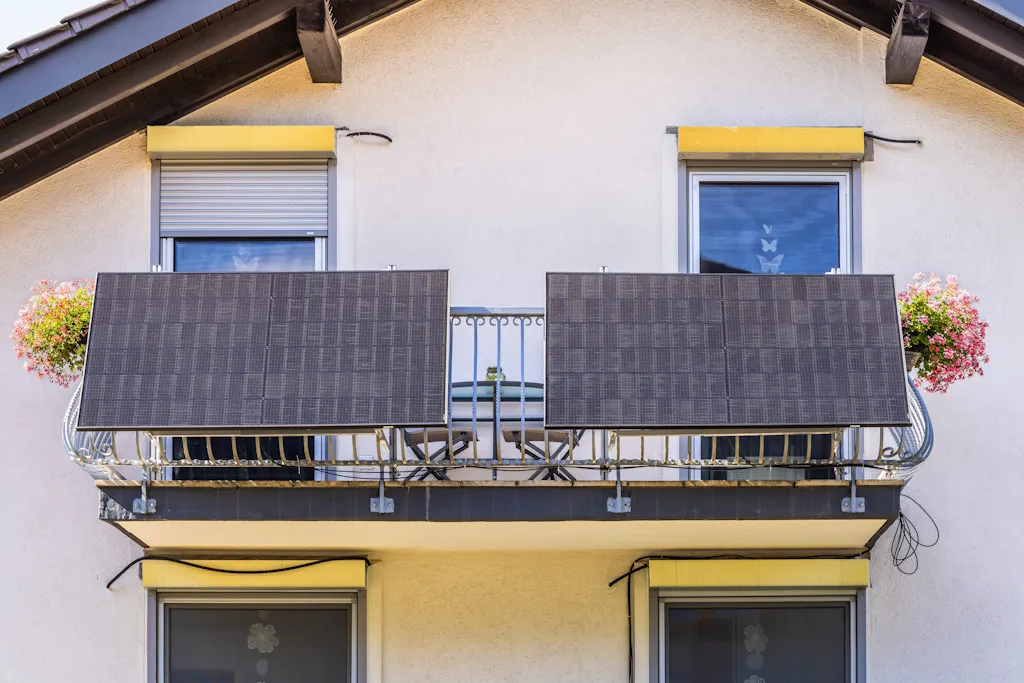
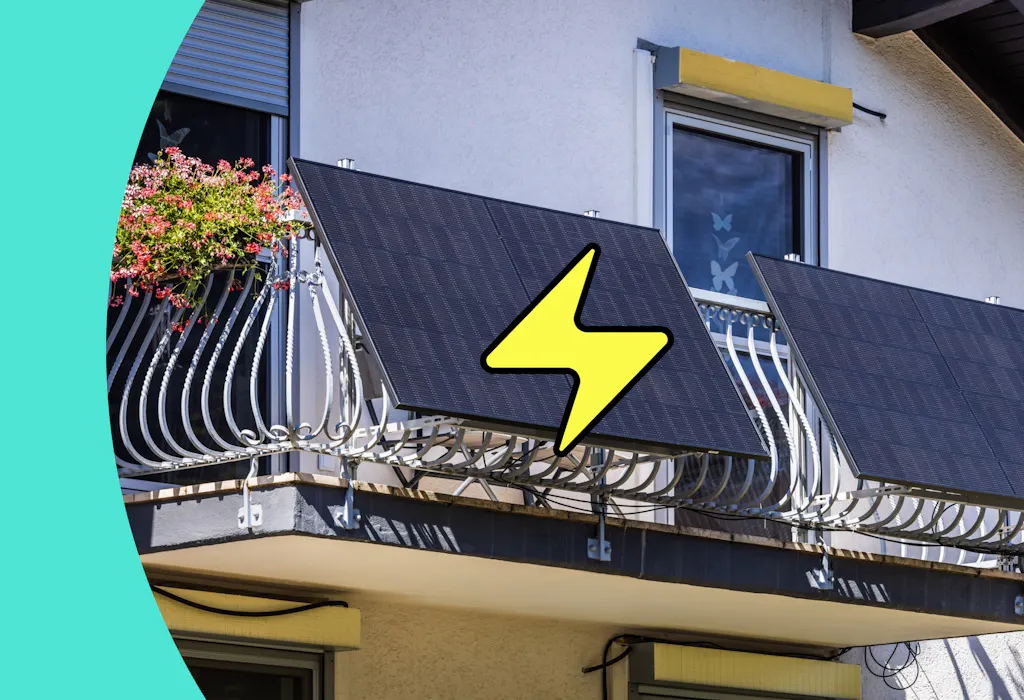
Balcony solar panels, also known as plug-in solar panels, can be self-installed and plugged directly into a mains socket, just like most electrical devices.
This enables households to reduce their energy bills by producing free solar electricity, without having to pay an installer.
These systems are especially good for people in flats who can’t get rooftop solar, but do have a balcony or garden they can use.
They don’t meet the current safety regulations for electrical installations in the UK, and therefore require you to hire a qualified electrician – but in March 2026, the government announced they’d update the guidelines “within months”.
When this happens, people will be able to fit plug-in solar panels themselves – and reduce their energy bills by up to £70-£110 per year, according to the government.
For more information, read our full guide to plug-in solar panels.
2. Private rooftop systems
Most flat residents won’t be able to go solar in this way.
You can only get a private rooftop system if you own the top-floor flat and have access to (or rights over) the roof, but this is the exception, not the rule.
In most leasehold arrangements, the roof belongs to the freeholder, not to any individual leaseholder – including the top-floor flat owner.
The lease agreement defines the ‘demised premises’ – that is, what you own – as well as the ‘retained parts’, which the freeholder still controls.
Under the agreement, you’ll usually own the internal walls, floors, and ceilings of your flat, while the freeholder retains the roof, foundations, external walls, and communal facilities.
So the ceiling will be yours, but – even though you live directly beneath it – you won’t automatically have control over the roof.
Some leases do explicitly give the top-floor leaseholder rights over the roof – or at least some roof space – but this must be stated in the lease. If it isn't, you don’t own any of the roof.
3. Shared rooftop systems
Your freeholder may choose to get a shared rooftop system installed.
A single three-phase solar inverter can then take electricity from this system and distribute it fairly across multiple flats in the same building.
Australian company Allume Energy has created a setup like this, called Solshare, which allows freeholders to decide how much solar electricity each flat receives.
They can share this energy equally, give more of it to larger flats, or apportion it in any other way they want – including using solar electricity to power common areas.
Flat residents can find out how much solar electricity they’re using online, and any household that doesn’t want to participate can just opt out.
And like most solar installations, this is ‘behind the meter’ technology, meaning it physically routes solar electricity into each flat's existing meter.
Residents therefore remain customers of their chosen electricity supplier, and each flat behaves as if it has its own private solar connection – which keeps things nice and simple.
The first UK installation of SolShare technology was in 2023, at a residential apartment building in Cardiff. It was funded by the Welsh government, with Allume Energy estimating that each of the 24 flats could save around 50% on their electricity bills.
And in June 2025, E.ON invested £4 million in Allume Energy to bring the firm’s tech to the UK.
How to access SolShare
Allume Energy markets this technology to landlords, housing developers, and social housing operators, because the decision to get it lies with the owner of the apartment block.
Landlords are attracted by the opportunity to lower their residents’ energy bills – which makes the buildings more appealing – and to boost the EPC rating of their flats.
This matters because in January 2026, the government confirmed that private landlords in England and Wales must ensure all their properties have an EPC rating of C or above by October 2030, unless they have an exemption.
However, you may also be able to get a shared solar panel system if you and other residents of the block have a ‘share of freehold’.
In a ‘share of freehold’ building, all the leaseholders collectively own the freehold company, meaning the roof is jointly owned by all of them.
No single flat owner can make decisions about the roof unilaterally – so any works, including solar installations, require the group’s consent.
In a small building with, let’s say, two or three flats, you’d usually need every co-owner to agree to the installation – but in larger blocks, a majority may be enough, depending on the way that building’s residents’ management company works.
4. Council action
Local authorities in the UK will sometimes get solar panels installed on the roofs of apartment blocks they own.
There’s not much you can do to make this happen, beyond contacting your local authority and asking if they’d consider it. It may be worthwhile, since any solar installation on your building would benefit you.
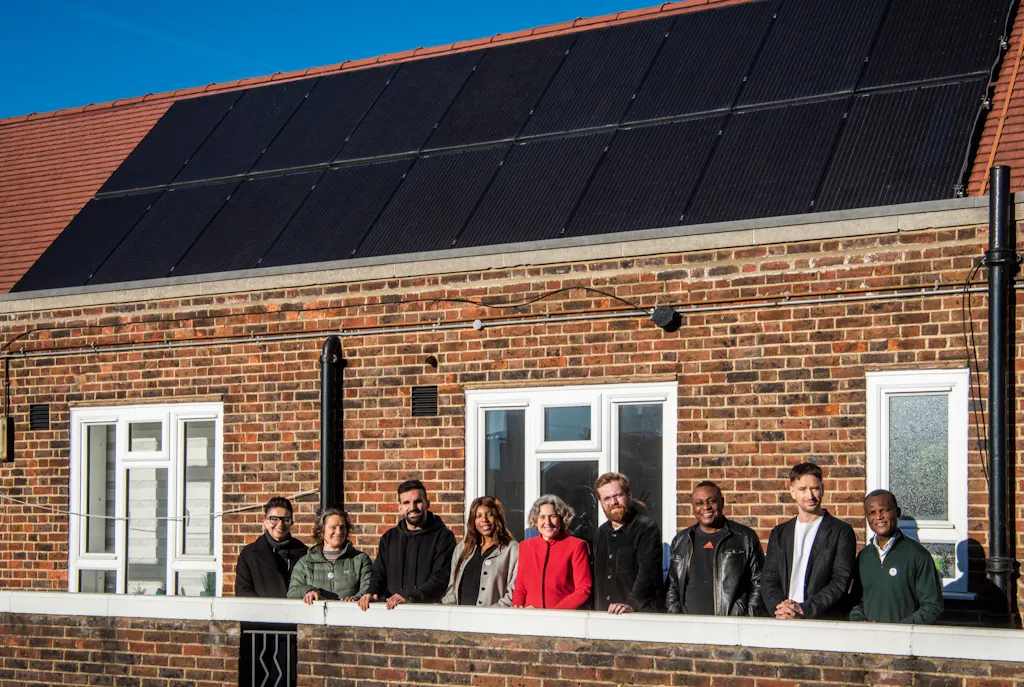
For example, in 2024, Hackney Council partnered with local solar installer Emergent Energy to put panels on council-owned residential estates in the area.
The firm began putting systems on roofs in 2025, and there are now solar panels working on 27 blocks, across three estates.
Unfortunately, the council had to exclude some blocks, as their roofs weren’t “strong enough for panels”. This is likely because the vast majority of apartment blocks have flat roofs – and many flat roofs aren’t suitable for solar panels.
Cables carry electricity straight from the panels to the homes that have signed up, and any excess energy is used in communal spaces or sold to the grid.
Residents can sign up for free to the scheme, which the council has said will aim to save households around 15% on their electricity bills.
Revolutionary microgrid technology
This Hackney Council project required Ofgem to create new rules governing the use of microgrids in apartment buildings.
Previously, the electricity produced by solar panels on apartment blocks could only be used to power communal areas or be sold to the grid.
In 2023, Ofgem gave Emergent Energy permission to conduct a trial in which flat residents could use the electricity produced by the building’s solar panels in their own homes, and still switch energy suppliers.
The firm created a network in each building that sits between the grid and residents, called a microgrid, which effectively turned the operator (Hackney Council, in this case) into an energy supplier.
The report on this trial isn’t due until May 2027, but if it’s successful, Emergent Energy believes it could be implemented in 5.4 million flats across England and Wales, “potentially generating 6.75GW of solar power”.
Standalone battery storage for flats
One exciting alternative to solar for people in flats is a standalone battery.
About 94% of new solar panel installations in the UK include a battery, according to data from Flexi-Orb and EPVS, but battery-only installations are now also becoming popular.
You can save money with a standalone battery by using it to import cheap, off-peak electricity overnight, via a time-of-use tariff, and then powering your home with that supply in the daytime.
This should allow you to avoid buying any (or much) peak electricity, which is much more expensive.
You can also join a virtual power plant (VPP), which brings together households with batteries, renewable energy systems like solar panels, and/or smart devices under one umbrella.
The company running your VPP operates all the batteries as one unit, and collectively charges or discharges at certain times to help the grid. It gives homes access to wholesale markets that they wouldn't be able to benefit from alone.
This helps to avoid power cuts, reduce grid operation costs, and make electricity less expensive at peak times – all while putting some extra money in your pocket.
Modern batteries are often compact enough for flats, with manufacturers like Anker and EcoFlow now selling models that are ideal for smaller spaces.
And you shouldn’t have to wait too long to make your money back: standalone batteries hit their break-even point in five to eight years, according to Capture Energy.
This market is still in its infancy, so we’ll expand on this opportunity for flats as more information emerges.
Summary
Going solar should soon be possible for many people who live in flats, once the government has updated regulations regarding plug-in solar panels.
Otherwise, switching to solar in a flat is pretty complicated. If you share the freehold with everyone else in your building, it’s possible – but if you’re a leaseholder, it’s usually not.
We’d encourage renters to reach out to their apartment block’s owner – whether that’s a private landlord or the council – and suggest they install panels on the building.
If going solar isn’t possible in your flat right now, you could look into getting a standalone battery, though the market is still pretty new.
And if you live in a house and want to find out how much you could save with a solar & battery system, enter a few details below and we'll provide an estimate.
Find out how much you can save
What kind of home do you live in?
Solar panels for flats: FAQs
Related articles
 Josh Jackman
 Josh Jackman
 Melody Abeni
 Josh Jackman
Written byJosh Jackman
Josh has written about the rapid rise of home solar for the past seven years. His data-driven work has been featured in United Nations and World Health Organisation documents, as well as publications including The Eco Experts, Financial Times, The Independent, The Telegraph, The Times, and The Sun. Josh has also been interviewed as a renewables expert on BBC One’s Rip-Off Britain, ITV1’s Tonight show, and BBC Radio 4 and 5.