- Solar advice hub
- How-solar-works
- Do solar panels need direct sunlight?
Do solar panels need direct sunlight?
Here's why solar panels don't need direct sunlight, how clouds affect them, and what you can do to maximise their output in all conditions.


Why you can trust our content
We know that the solar industry is full of misinformation, but we only use reliable sources, including:
- Our experienced solar experts, installers and system designers
- Our own database of solar & battery system designs
- Authoritative bodies like MCS and the UK government



Calculate savings
What kind of home do you live in?


Calculate savings
What kind of home do you live in?
At a glance
If you’re going to get a solar panel system, you want it to be worth the investment – and in our often cloudy country, it’s easy to question whether you’ll save much on your energy bills.
Fortunately, solar panels work well with any kind of natural light, and a good installer will ensure your system makes the most of the direct (and indirect) sunlight it receives.
In this guide, we’ll explain how this works, how clouds could affect your system, and what you can do to maximise your solar panels’ output in all conditions.
If you’re wondering how much you could save with a solar & battery system, enter a few details below and we’ll provide an estimate.
Find out how much you can save
What kind of home do you live in?
Do solar panels only work in direct sunlight?
Solar panels work in direct and indirect sunlight, as they just need daylight to function.
A rooftop system is ready to go at any time – all it needs to produce electricity is a supply of photons to dislodge the electrons in the panels’ silicon atoms.
Photons are present in all types of natural light, so whether the sun is shining directly onto your panels, reflecting off your pond, or coming through clouds, it’ll make your system generate electricity.
So at any time during the day, your panels should function. They just won’t work at night.
To fully thrive though, direct sunlight is better for panels, as it’s a more plentiful source of photons. That’s why solar installations in places that often enjoy clear, sunny skies – such as California, Egypt, and Spain – produce so much electricity.
In contrast, when sunlight reflects off surfaces like clouds and buildings, it scatters. This reduces the light’s intensity, also known as its ‘solar irradiance’, and you end up with indirect (or ambient) light.
However, solar panels still work extremely well in the UK, despite our frequently cloudy weather. We’ll explore this more below.
And for more information on the science behind solar, check out our guide to how solar panels work.
Do solar panels work on cloudy days?
Solar panels do indeed work on cloudy days, though their output varies depending on the amount of cloud cover.
Light clouds, such as delicate, wispy cirrus varieties, will naturally have a much smaller impact on your solar panel output than thicker types, like cumulus clouds.
None of these clouds will block the light entirely, though. Unlike buildings or humans, which cast sharp, well-defined shadows, clouds scatter all the light that hits them – and some of these rays will hit your panels.
And even when it is heavily overcast and your system’s production levels are low, you can take comfort in the knowledge that any rain will clean your solar panels and improve their output moving forward.

What’s the impact on solar output?
Clouds certainly reduce solar output, but it’s not totally clear by how much, and the phenomenon hasn’t been researched much in western Europe.
However, recent studies in Uzbekistan and Nigeria have shed some light on the subject, and provide a useful – if not definitive – indication of how clouds affect solar production levels.
In 2025, a scientist at Tashkent State Technical University found that light cloud cover reduces solar output by 30% to 70%, depending on exactly how light it is.
On the other hand, the research indicated that heavy cloud cover can result in output losses of 90% to 95% – though still never 100%.
And in 2023, research by physicists at Nigeria’s University of Port Harcourt showed a 23.8% drop in output due to light cloud cover, and a 66.8% reduction when there was heavy cloud cover.
This may sound like a large drop in output, but the average solar panel system in the UK still produces enough electricity to massively reduce your energy bills (more on this below).
And when the clouds move on, your system should ramp back up to full productivity pretty much straight away.
What is the ‘edge of cloud’ effect?
The edge-of-cloud effect – also known as ‘cloud edge glint’ or ‘cloud enhancement’ – can temporarily increase solar output.
When sunlight shines through the very edge of a cloud, its water molecules scatter and bend the light, making it more concentrated as it passes through.
The edge-of-cloud effect typically causes a temporary 47% spike in solar output when sunlight passes through one cloud, according to University of California San Diego researchers.
When the light goes through the edges of two clouds, you can expect a 63% increase in solar output, on average.
Evidently, some clouds come with a silver lining, but a clear sky is still your best bet for maximum solar output.
Solar panels in cloudy UK weather
A large chunk of solar generation happens away from the cloudy winter months, with the average system producing about 38% of its total output in summer, according to Sunsave data.
This makes sense – a sunny, clear sky is always the best environment for solar panels, to the extent that your system will sometimes generate more electricity than you need.
You can sell all of this excess energy to the grid for hundreds of pounds per year, as long as you sign up for one of the best export tariffs.
Thankfully though, your system will still produce plenty of electricity throughout the rest of the year, since the technology only requires photons to function.
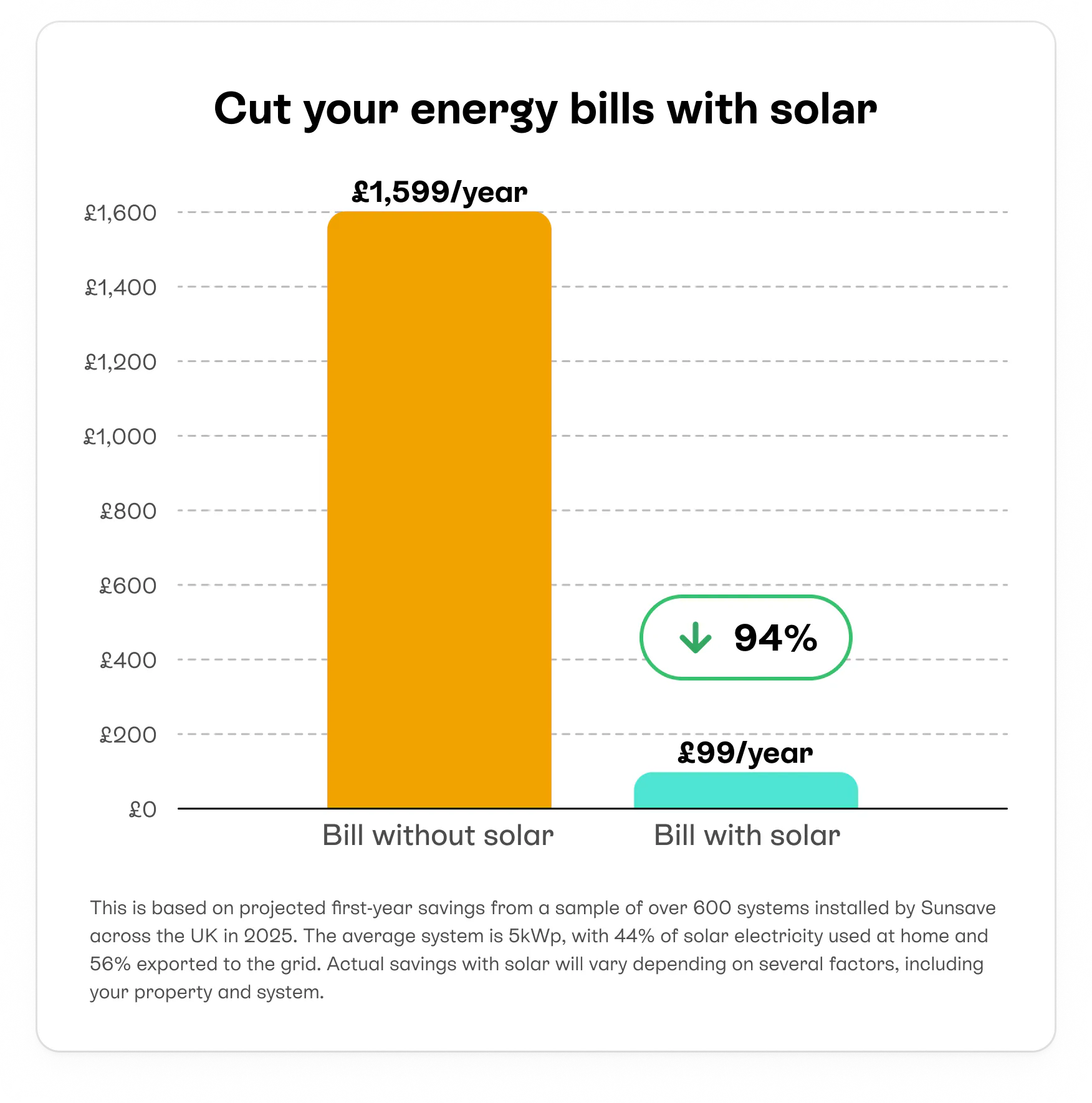
In fact, on average, you could save 94% on your electricity bills with a solar & battery system.
This is based on projected first-year savings from a sample of over 600 systems installed by Sunsave across the UK in 2025. The average system is 5kWp, with 44% of solar electricity used at home and 56% exported to the grid.
Actual savings with solar will vary depending on several factors, including your property and system.
Ensuring strong solar output in cloudy weather
To make sure your system produces as much electricity as possible, even in cloudy weather, you should choose one of the best solar panel installers around.
A good installer will design the most effective system for your home, which involves making the most of your roof space, optimising your panels’ angle and direction, and not cutting any corners – with either your kit or the installation itself.
It’s only with a properly installed system that you can maximise your energy bill savings, helping you reach – or exceed – the 94% savings figure we mentioned earlier.
If you’re wondering how much you could save with a solar & battery system, enter a few details below and we’ll provide an estimate.
Find out how much you can save
What kind of home do you live in?
FAQs




Related articles
 Josh Jackman
 Josh Jackman
 Melody Abeni
 Joanna Hunter
Written byJosh Jackman
Josh has written about the rapid rise of home solar for the past seven years. His data-driven work has been featured in United Nations and World Health Organisation documents, as well as publications including The Eco Experts, Financial Times, The Independent, The Telegraph, The Times, and The Sun. Josh has also been interviewed as a renewables expert on BBC One’s Rip-Off Britain, ITV1’s Tonight show, and BBC Radio 4 and 5.