- Solar advice hub
- Solar-technology
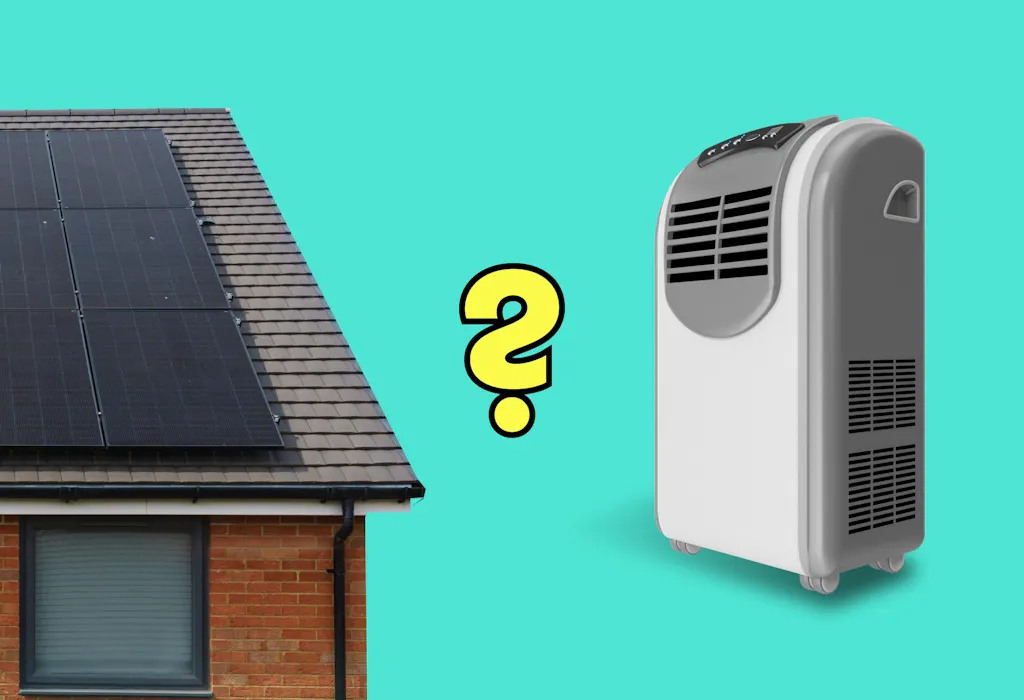
- Do solar panels work with air con?
Do solar panels work with air con?
Air con is becoming a necessity for UK homes – and solar panels can cut your running costs. Here's everything you need to know.


Why you can trust our content
We know that the solar industry is full of misinformation, but we only use reliable sources, including:
- Our experienced solar experts, installers and system designers
- Our own database of solar & battery system designs
- Authoritative bodies like MCS and the UK government



Calculate savings
What kind of home do you live in?


Calculate savings
What kind of home do you live in?
At a glance
UK summers are getting increasingly insufferable as heatwaves arrive hotter and more frequently, leading millions of homes to embrace air conditioning.
But with energy bills already high, and unlikely to fall significantly any time soon, this will just stretch households' finances further – unless they power a significant chunk of this extra usage with solar panels.
In this guide, we'll run through how a solar installation and air con unit work together, roughly how many panels you'll need to run your air con, and what you can expect to save.
If you’re wondering how much you could save with a solar & battery system, enter a few details below and we’ll provide an estimate.
Find out how much you can save
What kind of home do you live in?
The growing need for air con in the UK
In the 20th century, there was practically no need for air conditioning in the UK, as our climate was mild, and heatwaves were short and manageable.
That’s no longer true. We experienced more than three times as many days over 30°C between 2015 and 2024 than we did from 1961 to 1990, on average.
This has had deadly consequences. In May and June 2026 alone, more than 2,700 people died from heat-related causes – and for most of that time, it wasn’t even summer.
Our climate is set to continue along this path, with the Met Office saying it “may be possible” for the UK to hit 45°C or higher in the current climate, while we could see “a month or more” of at least 28°C.
With no end in sight, households are turning to air conditioning to cope. Four million UK homes now have either portable or built-in air con systems – double the figure from three years ago, and 14% of all households.
92% of UK homes will be at risk of overheating by 2050, and air con will be part of the solution.
The independent Climate Change Committee (CCC) has said that “the intensity and duration of future heatwaves mean that we need to plan for more active cooling (such as air conditioning).”
This view is also supported by the United Nations Children's Fund (UNICEF), which has said “household air conditioning reduces the risk of heat-related deaths by approximately 75% compared to those without it.”
How do solar panels and air con work together?
Getting air con means sharply increasing your home’s electricity consumption (more on this below) – and solar panels produce free power.
You don’t need any special equipment to connect an air con unit to your solar panels; it’ll just be another appliance for the system to power.
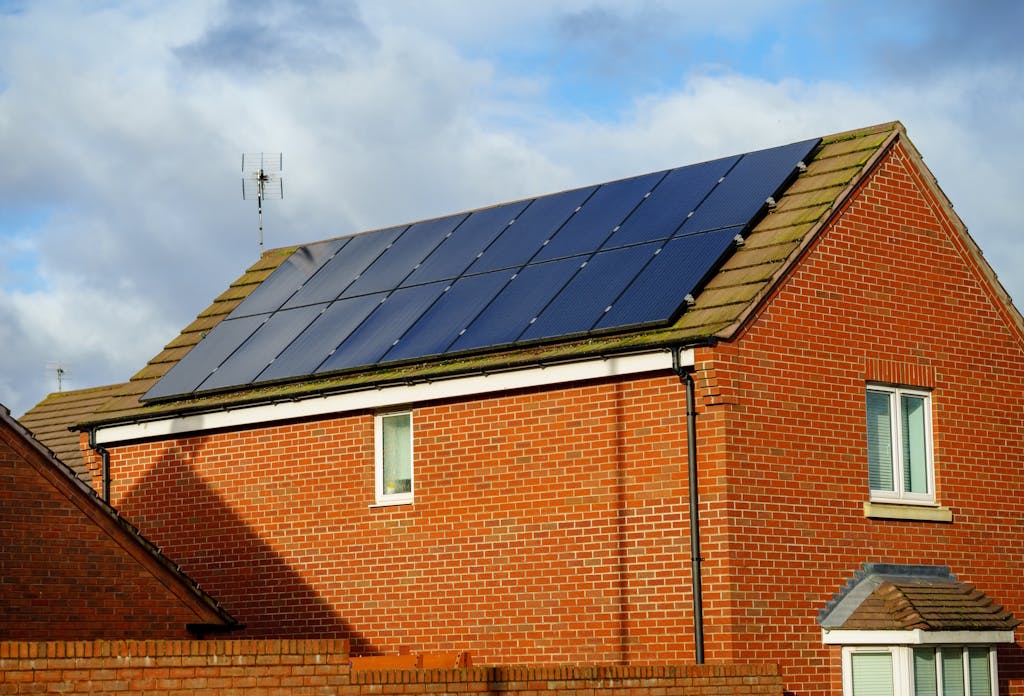
Your panels will produce electricity, your inverter will convert it from Direct Current (DC) to Alternating Current (AC) electricity, and it’ll go directly to power any devices in your home that need it – including the air con.
If your system is generating more electricity than your household needs, the excess will either go to your solar battery or the grid. If you export it, you can get paid for every kilowatt-hour via an SEG tariff.
As you add more energy-intensive appliances, such as air con, you’ll use a higher percentage of the electricity your panels produce (known as ‘self-consumption’). This is usually better financially than selling it to the grid.
How much electricity does air con use?
The amount of electricity your air con uses will depend on multiple factors, including its power, efficiency, and whether it’s portable, a one-room system, or a whole-home setup.
Your household will also have an impact, particularly when it comes to your insulation levels, your room layout, and how often you turn on the air con.
A portable unit consumes around 1.176 kilowatt-hours (kWh) of electricity per hour, according to EDF, which adds up to 1,286kWh annually, if you use it for six hours per day on average, across six months.
This tallies with a 2025 study that looked at nearly 700,000 households in 25 countries – including ones with similar climates to the UK, like Germany and the Netherlands – and found air con “increases households’ electricity consumption by 36%, on average”.
For the average UK household, which uses 3,400kWh of electricity per year, this would equate to an extra 1,224kWh – which is almost exactly the same as EDF's estimate.
If you’re wondering how much you could save with a solar & battery system, enter a few details below and we’ll provide an estimate.
Find out how much you can save
What kind of home do you live in?
Sizing your solar panel system for air con
Designing a solar panel system to meet your needs is always tricky, as it depends on your electricity usage, location, and roof size, among other factors.
For instance, a home with a west-facing roof in north England will almost certainly need more panels to produce the same amount of electricity as a household with a south-facing roof on the Isle of Wight, everything else being equal.
A good solar installer will be able to assess your requirements and roof, and come up with the best possible solution for your household.
However, if we take the average UK home with air con, which uses 4,624kWh per year, and put it in Dunsop Bridge – the centrepoint of the British Isles – with a south-facing roof, it'd need a 5.2kWp system.
You could achieve this by getting 12 solar panels, each with a power rating of 450 watts (W).
Its generation levels will be uneven, meaning it'll produce much more electricity in summer and considerably less in winter – but this aligns perfectly with when you'll need air con.
Consider your air con unit’s power rating
To make the most of your well-sized solar panel system, you'll also need an inverter that can provide enough power to your air con unit in the instant it's required.
Every inverter comes with a kilowatt (kW) rating that shows how much electricity can flow through it at any given time, and your air con unit will have a rating too.
So for example, if you have a one-room, single-split air con system that's using 2.5kW, and the rest of your home is consuming 2kW, you'll need a 4.5kW inverter to power everything in your household at once.
Even if you're barely using any electricity in the rest of your home, you'll need an inverter capacity that's at least equal to your air con unit's rating.
It's like sending water through a pipe: if you want to pour more through it at once, you'll need a larger pipe – or in this case, a bigger inverter.
If the inverter isn't large enough to cope with your home's demands – say it's 3kW instead of 4.5kW – you'll have to make up the 1.5kW difference with electricity from the grid.
A UK home with air con and solar panels will still probably need to buy some grid electricity, because solar output varies day to day, but the right size inverter will let your panels contribute as much as possible – which means higher savings.
To learn more, check out our guide to solar inverters.
Save on air con running costs with solar
The average UK home uses around 1,224kWh per year to power its air con unit, as we explained earlier, which costs £320 on the July 2026 energy price cap.
If your solar panels can fully power your air con, you'll reduce this to £0 – but that's unlikely.
After all, the temperature can still be high enough for air con when the sun isn't shining directly onto your panels, and it can stay hot even after the sun's gone down.
In the more typical case that your panels cover around 50% of your air con's running costs, the average home will save around £160 per year.
If your solar installation includes a battery, this will boost your savings by enabling you to run your air con on solar electricity at night – which is especially important if it stays hot after the sun sets.
However, this is still a country where it only gets seriously hot for several weeks per year – so while cutting your air con costs with solar electricity is a welcome bonus, it's not the main reason to go solar.
The vast majority of your solar savings will come from powering a large percentage of your household's daily usage across the year.
Is it worth installing air con with solar panels?
Air con and solar panels work excellently together, since both have a starring role when the sun is beating down.
It's getting increasingly necessary for UK homes to install air con units, but it's expensive to run them on grid electricity – and a solar installation can massively reduce this cost.
Then for the rest of the year, your panels can continue providing electricity that cuts your household's energy bills.
However, solar panels are expensive – which is why you should consider Sunsave Plus, which gets you a solar & battery system with no upfront cost.
You’ll receive the best-in-class kit, access to the best export tariffs, and the 20-year Sunsave Guarantee, which comes with 24/7 monitoring, maintenance, a free battery upgrade, a free inverter replacement (if required), and downtime cover – all for a fixed monthly fee.
If you’re wondering how much you could save with a solar & battery system, enter a few details below and we’ll provide an estimate.
Find out how much you can save
What kind of home do you live in?
FAQs



Related articles
 Melody Abeni
 Josh Jackman
 Charlie Clissitt
 Josh Jackman
Written byJosh Jackman
Josh has written about the rapid rise of home solar for the past seven years. His data-driven work has been featured in United Nations and World Health Organisation documents, as well as publications including The Eco Experts, Financial Times, The Independent, The Telegraph, The Times, and The Sun. Josh has also been interviewed as a renewables expert on BBC One’s Rip-Off Britain, ITV1’s Tonight show, and BBC Radio 4 and 5.