- Solar advice hub
- How-solar-works
- Can you go off-grid with solar panels?
Can you go off-grid with solar panels?
Here are all the steps to going off-grid with solar panels, how much it costs, and why it should be supplemented with other energy sources.


Why you can trust our content
We know that the solar industry is full of misinformation, but we only use reliable sources, including:
- Our experienced solar experts, installers and system designers
- Our own database of solar & battery system designs
- Authoritative bodies like MCS and the UK government



Calculate savings
What kind of home do you live in?


Calculate savings
What kind of home do you live in?
Off-grid with solar: at a glance
Solar panels can be a productive source of energy, whether you’re connected to the grid or not, so it makes sense to consider using them to power your whole home.
Unfortunately, relying exclusively on solar energy to go off-grid is expensive and inefficient, so you’re better off using multiple power sources.
In this guide, we’ll run through the steps to going off-grid with solar panels, how much it costs, and why it should be supplemented with other energy sources.
At Sunsave, we don't install off-grid solar, but our systems will significantly reduce your reliance on the grid. To find out how much you could save, enter a few details below and we'll provide an estimate.
Find out how much you can save
What kind of home do you live in?
Living off-grid with solar panels
Solar panels can supply a significant chunk of an off-grid home’s electricity, but it’s not realistic to expect them to supply all of your power.
Households that have been forced to stay off-grid because of eye-wateringly high grid connection costs often use solar panels, though usually alongside other renewable energy systems, like wind turbines.
Going off-grid by choice is a huge decision that involves an incredible amount of planning, work, and money, making it much less idyllic and rewarding than it may seem.
You’ll escape the grim cycle of paying high energy prices for each unit of electricity you use, and anyone making this move should strongly consider getting a solar & battery system.
But if you want to rely entirely on solar power all year round, the upfront cost could exceed £50,000. More on that below.
How many people live off-grid in the UK?
Around 2,000 households are off-grid in the UK.
At least 350 of these are in Northumberland , though Christine Nicholls of Community Action Northumberland has said there could be 500 or more in the county.
Most of these 2,000 homes were missed out by the UK’s free electrification programmes in the 1950s, 60s, and 70s, and would rather have mains electricity than keep dealing with the high costs, power cuts, and inconveniences of off-grid life.
Unfortunately, they’re often priced out by costs that can run into the tens of thousands of pounds – or higher.
How much would it cost them to connect to the grid?
The typical price for a domestic grid connection is £2,500, excluding VAT.
VAT is charged at 0% if the home is being built at the same time, but these existing households will pay a 5% rate, for a total of £2,625.
However, most off-grid properties face vastly higher connection costs.
Distribution Network Operators (DNO) – the companies that run the hardware supplying us with electricity – charge more for remote locations far from a power supply, and for underground installations.
Northern Powergrid, which covers north-east England, told The Guardian: “Generally, underground connections are around three times the price of an overhead one.”
But this is necessary in places where overhead powerlines aren’t allowed – like Northumberland National Park – which isn’t the fault of the households there.
Northumberland resident Steve Batey received a £478,000 quote from his DNO, Northern Powergrid, to connect him and two neighbours.
Newcastle smallholder Clive Johnson, 61, lives in a mobile home 50 metres from the electricity supply for a housing development. In 2013, he was quoted £40,000 for a mains connection.
And Vanessa Corby, who also lives in Northumberland, was quoted £44,000 for a grid connection in 2017.
She said powering her home was costing her £800 per month, adding: "People dream of living off grid, but it's a nightmare."
Is it possible to go off-grid with solar panels?
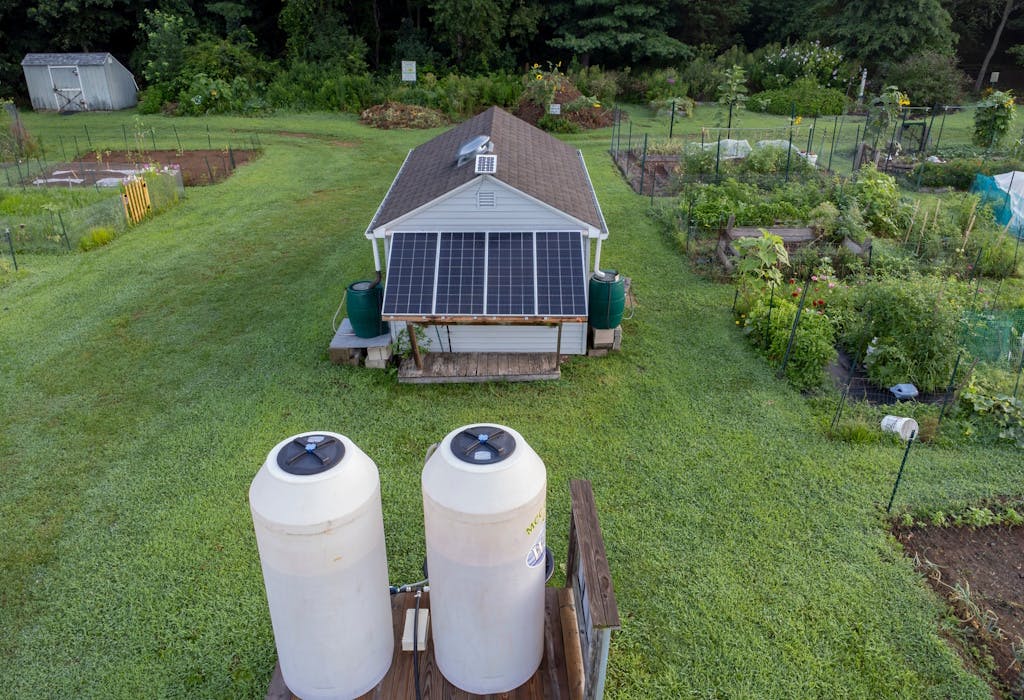
It’s theoretically possible to go off-grid with just solar panels, but there’s no simple answer for all households.
A solar & battery system can supply an off-grid home with variable amounts of electricity across the year, but it probably won’t consistently power your home unless you make a massive investment.
In fact, the system cost may end up far exceeding the grid connection price (more on this below).
Vary your methods a bit though, and you could build a viable network that features solar panels as a key member of the band, rather than a solo act.
The Energy Saving Trust has rightly said that, for off-grid homes, “a renewable electricity generation system – using wind, water, or solar power to generate power – could be the answer.”
You’ll just probably need to use more than one of these methods.
After all, solar output is highest in summer and lowest in winter, while wind turbines and hydropower systems are most productive in winter.
Some combination of these systems – possibly with the help of a backup generator – could provide you with a network that can power your home throughout the year.
At Sunsave, we only install grid-connected systems. If you’re wondering how much you could save with a solar & battery system, enter a few details below and we’ll provide an estimate.
Find out how much you can save
What kind of home do you live in?
How to go off-grid with solar panels
There are some key steps you need to take if you want to go off-grid with solar panels while ensuring that you have a consistent supply of electricity all year round.
1. Scale down your electricity usage
To give your solar panels the best chance of covering your electricity needs, the first and best step you can take is to reduce the amount of electricity you consume.
Get rid of all your appliances that require large amounts of electricity all at once, like electric kettles, which usually require a short, three-kilowatt (kW) burst of power.
Instead, you can heat up a whistling kettle on your hob – which means you’ll need a regular supply of a fuel like gas or oil.
If ordinary household devices like kettles are out, it follows that a heat pump or EV charger would use far too much electricity to make sense for your off-grid home.
You’ll already require a large solar panel system to make a significant dent in your electricity consumption. If all your appliances were electric, you’d need an enormous installation.
Instead of a heat pump, you could – for example – use a log burner or biomass boiler to heat your house and water, possibly with help from a solar thermal system.
You should also consider alternatives to washing machines and tumble dryers, such as hand-washing and hanging your clothes up on a line.
This will free up electricity for more crucial high-usage items, like a fridge or freezer, which have to be on constantly.
When it comes to these energy-intensive appliances, make sure you get the most efficient models possible, since any reduction in usage will add up over time.
2. Consider additional renewable energy sources
You should look into taking advantage of other renewable energy sources, like wind and hydropower.
Solar panels will produce far more electricity than you need in summer, but far less than you need in winter.
Grid-connected homes can sell all this excess in the summer for a profit, and then rely on the grid in the winter.
Naturally, off-grid homes can't do either of these things, and need to find an alternative source of renewable power in the colder months.
One excellent alternative is a wind turbine. A 1.5kW model should generate around 300 kilowatt-hours (kWh) per month in an area with an average annual wind speed of 14 miles per hour (mph).
Considering the UK-wide average wind speed across the past 20 years is 10mph, you can expect your turbine to produce around 210kWh per month, or roughly 2,500kWh per year.
This is most of the 3,400kWh that the average household uses annually, and if you’ve reduced your consumption effectively, it could provide all the electricity you need – though like solar, wind is also seasonal.
Your turbine will generate more power in winter than in summer though, which is the perfect counterbalance to solar energy.
Like your backup generator, wind turbines are usually installed on the ground outside your home, then wired straight into your house’s mains, like solar panels.
Roof-mounted models are available, but the technology is still young and niche.
3. Get a backup generator
You should build a network of renewable energy systems, so you’re never left relying on one source to provide you with all your energy – but even with that setup, you should have a backup.
This is where generators come in. When the sun’s gone down and the wind isn’t blowing – or if you want to run a particularly high-consumption item – you can turn to your backup source.
These heavy, box-shaped machines usually run on diesel, though you can get gas, propane, and petrol models.
If you’re primarily relying on solar panels to power your home, you’ll likely need a large generator you can lean on throughout winter, when the days are short and often overcast.
How much does an off-grid solar & battery system cost?
An off-grid solar & battery system designed to cover an entire home’s electricity needs can cost tens of thousands of pounds.
For example, a large solar panel system with a couple of batteries would cost “at least £50,000”, according to analysis performed by solar installer Spirit Energy – and that was in 2021.
Admittedly, this hypothetical design did include a heat pump, but even if you heat your home with a different fuel and keep your usage low, you’d need a massively expensive system to run everything on solar electricity.
A solar battery costs around £3,000-£7,000, depending on its size – but that’s for a grid-connected home that doesn’t have to worry about frequent power outages.
Your panels will be much less productive in the winter months, so you’ll need your battery storage to step up in a major way, to hold on to every last kWh for as long as possible.
This wouldn’t be cost-effective at all, as you’d need an oversized amount of battery storage that would then be horribly underused in winter. It doesn’t make financial sense, and it’d be very bad for the batteries’ lifespan.
You’ll also need to monitor and maintain the installation across its decades-long lifespan, potentially with a local professional’s help, which will naturally cost more with a larger system.
And if you don’t scale up your system to this extent, you’ll have to deal with regular power outages.
Is it worth going off-grid with solar?
It’s not worth going off-grid with just solar, as it’s extremely expensive and will leave you vulnerable to power cuts.
If you’re off-grid because your grid connection cost is too high, a solar & battery system can be an excellent option, but not on its own – even if you keep your usage low.
You should get a backup generator, and look into additional ways of producing renewable energy, such as wind and hydropower.
On the other hand, if you’ve chosen to live off-grid, you might want to reconsider. You can switch to solar and reduce your reliance on the grid, all while still staying grid-connected, and you wouldn’t have to face:
- the vast cost of a properly sized off-grid system
- the various issues associated with DIY solar installations
- the pain and inconvenience of regular power cuts
That’s why at Sunsave, we only install grid-connected systems. If you’re wondering how much you could save with a solar & battery system, enter a few details below and we’ll provide an estimate.
Find out how much you can save
What kind of home do you live in?
Off-grid solar panels: FAQs


Related articles

 Josh Jackman
 Josh Jackman
 Josh Jackman
Written byJosh Jackman
Josh has written about the rapid rise of home solar for the past seven years. His data-driven work has been featured in United Nations and World Health Organisation documents, as well as publications including The Eco Experts, Financial Times, The Independent, The Telegraph, The Times, and The Sun. Josh has also been interviewed as a renewables expert on BBC One’s Rip-Off Britain, ITV1’s Tonight show, and BBC Radio 4 and 5.