- Solar advice hub
- Installation
- Can you put solar panels on a shed roof?
Can you put solar panels on a shed roof?
Sheds aren't usually built for solar panels, unlike your main roof. Here's why it's probably not suitable, and your best alternatives.


Why you can trust our content
We know that the solar industry is full of misinformation, but we only use reliable sources, including:
- Our experienced solar experts, installers and system designers
- Our own database of solar & battery system designs
- Authoritative bodies like MCS and the UK government



Calculate savings
What kind of home do you live in?


Calculate savings
What kind of home do you live in?
Solar panels on sheds: at a glance
You can technically install solar panels on a shed roof, but it’ll need to undergo a series of structural tests to ensure that it’s suitable – and most won’t pass.
More than 1.6 million UK households now have solar panels, and homeowners are rightly looking to maximise their available roof space – so a shed may seem like a great place to put some extra panels.
Unfortunately, they’re not usually built for this kind of installation. Putting solar panels on a house roof is much more straightforward, and can save you much more on your energy bills.
We’ll happily consider your shed as an option, but if you have any space on your main property’s roof, this will almost certainly be a better bet. To find out how much you could save with a rooftop solar & battery system, enter a few details below and we'll provide an estimate.
Find out how much you can save
What kind of home do you live in?
Is your shed roof suitable for solar panels?
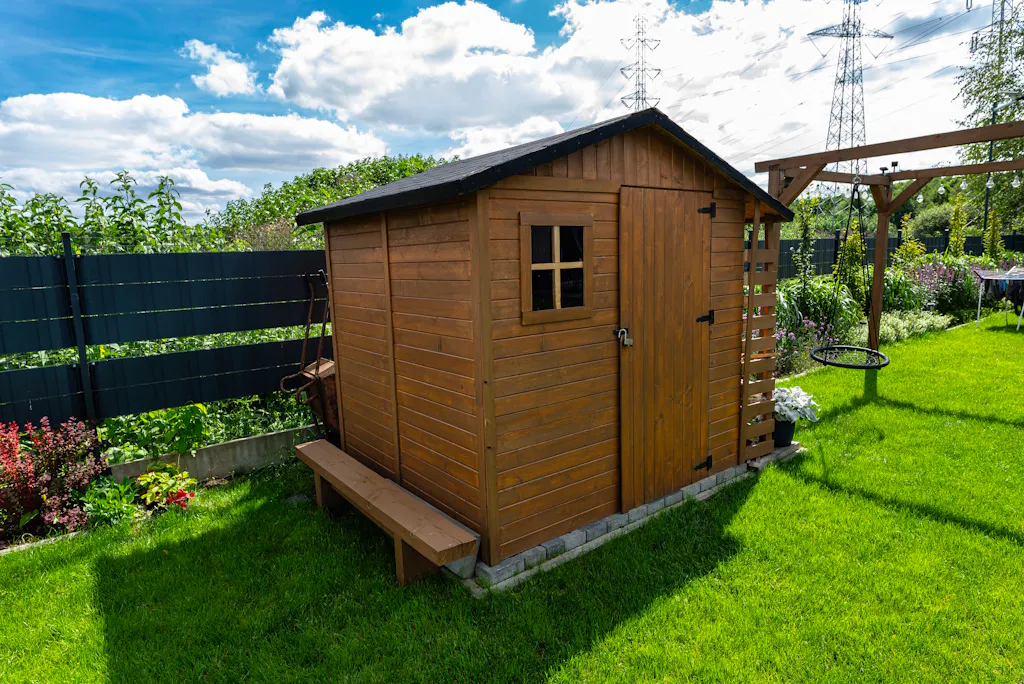
Shed roofs tend to be unsuitable for solar panels, as they’re usually made from lightweight timber and thin cladding.
These materials aren’t designed to carry the average solar panel, which weighs around 27kg, according to our analysis of 110 panels on the market.
In fact, they’re not normally meant to hold anything.
If your shed roof has rafters and is built from strong enough stuff to hold upwards of 100kg, you’ll need a professional installer to conduct an assessment before proceeding.
With a house roof, this is a routine check that installers often carry out remotely – but that’s not the case with shed roofs.
A good installer will perform a full, in-person structural survey, as many sheds either don't have rafters in the traditional sense, or have ones that are too thin or widely spaced to safely hold mounting brackets.
Without proper rafters, a good installer will not proceed – no ifs, no buts. This is a non-negotiable safety requirement.
You need rafters to provide a solid fixing point for the mounting system. If they can’t do this, the risk of your panels coming loose or the roof collapsing is too high.
Does your shed roof have the right tiles?
Even if your shed roof is structurally sound with good rafters, you’ll also need it to have tiles that work with solar panels.
An installer will almost always use brackets that connect to the rafters, and clip around or under the roof tiles. This approach works well with standard concrete or clay roof tiles, which are common on houses in the UK.
It’s also possible to install solar panels on top of slate tiles.
However, a lot of sheds are covered in materials like felt, corrugated metal, corrugated plastic, or thin asphalt shingles that all cause a number of problems for installers.
Here are the main downsides for each type:
 Felt roofs are not robust enough to create a weatherproof seal around fixings, meaning your roof is much more likely to leak after the installation
- Corrugated metal or plastic requires specialist mounting equipment if it’s suitable, which is rarely worth the cost for a shed-based installation
- Thin asphalt shingles are unlikely to provide the necessary structural integrity around fixing points
A good installer should refuse to take the job if your shed has any of these coverings, and will only reconsider if you get appropriate roof tiles – that is, the same kind that’s used on houses.
If you have enough space on your main property’s roof, it makes much more sense to get panels there instead. To find out how much you could save with a rooftop solar & battery system, enter a few details below and we'll provide an estimate.
Find out how much you can save
What kind of home do you live in?
Is your shed roof big enough for solar panels?
Your shed roof is extremely unlikely to be big enough for a whole solar panel system.
It would have to be around 20m² to fit six panels, which is usually the minimum number you need to save enough on your energy bills for the cost to be worth it.
So if your shed is suitable for a solar installation, it’s best to treat it as a bonus place for a couple of extra panels, rather than as your primary solar location.
If you like the idea of getting panels on your shed to power the activities within – like a home office, gym, or space for DIY – this is doable, but it won’t have much impact on your energy bills.
How are solar panels installed on a shed?
If your shed is structurally safe, has the right tiles, and is large enough to fit at least some solar panels, an installer can proceed.
How they do so will depend on whether your shed is close to your home or not.
1. Solar panels on a shed close to your home
If your shed is near your home, an installer will find it relatively easy to make all the connections that a solar panel system requires.
They can run cables from the shed to your home’s fuse board in a couple of ways:
- Trench – your installer buries the cables underground, which avoids visible wiring, but makes the installation longer and more expensive
- Catenary wire – they hang the cables overhead, between your shed and home. This is quicker and cheaper, but it’s visible and can be subject to height requirements, particularly if people or vehicles often pass by underneath
The number of cables they’ll need to run between your shed and home depends on where the inverter and battery are.
If these items are inside your home, they’ll only need to set up a DC cable between the two buildings.
But if the machines are both in your shed, your installer will need to run an AC cable and communications cable to the fuse board in your home.
Your installer should make sure that all cabling follows the British Standard Guidelines for electrical wiring (BS 7671).
2. Solar panels on a shed further from your home
The further the shed is from your home, the more complicated and costly the cable run becomes, to the extent that these issues can outweigh the benefit of having more panels.
Long cable runs also increase the risk of energy loss (also known as voltage drop), which affects your system’s output levels.
In this case, it can be better to put the inverter and battery in your shed, to keep the DC cable run short – as long as you can keep these devices safe and protected from the weather.
What if your shed isn’t suitable for solar?
The vast majority of sheds aren’t suitable for solar panels, but thankfully, there are other options.
You can potentially use your garage, garden, or – probably most profitably – your home’s roof.
Just use your main household roof
The best option is always to use your main property’s roof, even if your shed is suitable for solar.
Your main roof will almost always be larger than your shed, meaning you can fit more panels on it, produce more energy, and therefore save more on your energy bills.
The price of an installation is made up of large fixed costs like labour and scaffolding, which rarely change based on the number of panels – so it makes sense to get as many panels as possible.
This is usually much more achievable on your main roof, as it tends to be your biggest roof. Shed roofs are also usually lower down and more at risk of shade.
If you have the luxury of choosing between two roofs – your home and your shed – a good installer will always advise going with your home’s roof.
Consider your garage roof
Your garage may well be a better candidate for solar panels than your shed, as they tend to be structurally stronger.
As long as your garage roof is pitched, receives enough daylight, and has tiles and rafters that suit a solar installation, an installer should suggest putting some extra panels on it.
For more information, read our guide to solar panels on garage roofs.
Get ground-mounted solar panels
If you have enough land, you may be able to get a ground-mounted solar panel system, but there are a couple of major drawbacks.
First, you’ll likely have to apply for planning permission, which most homeowners won’t need for a rooftop installation, as it generally falls under your permitted development rights.
You’ll require permission if you want your ground-mounted system to occupy more than 9m² of space, or if it’ll be taller than 4m², wider than 3m², or deeper than 3m² at any point.
If it’ll be less than 5m from any of your property’s boundaries, you’ll also need permission – and you’ll have to apply again if you ever want to add panels to your system.
It’s also much more expensive than other types of solar installations.
It costs about £27,000 to install a 10kWp solar panel system on the ground , compared to £18,460 to put it on your roof – making a ground-mounted system 46% more expensive.
With solar panel costs already putting off many UK households, it makes sense that residential ground-mounted systems are so rare.
To read more, check out our guide to ground-mounted solar panels.
Next steps
A shed can be suitable for solar panels, but only if it’s structurally safe, built with proper rafters, and covered in the right kind of roof tiles.
Most sheds don’t fulfil these criteria, so make sure you get a professional assessment before moving forward.
A good installer like Sunsave will inspect your shed (and the rest of your property), then put together the best system design for your household.
They’ll make the most of all available roof space, without cutting corners on safety.
To find out how much a solar & battery system could save you on your energy bills, enter a few details below and we'll provide an estimate.
Find out how much you can save
What kind of home do you live in?
Solar panels on a shed roof: FAQs

Related articles

 Melody Abeni
 Josh Jackman
 Josh Jackman
Written byJosh Jackman
Josh has written about the rapid rise of home solar for the past seven years. His data-driven work has been featured in United Nations and World Health Organisation documents, as well as publications including The Eco Experts, Financial Times, The Independent, The Telegraph, The Times, and The Sun. Josh has also been interviewed as a renewables expert on BBC One’s Rip-Off Britain, ITV1’s Tonight show, and BBC Radio 4 and 5.